A Content Writer for Your Online Store: Hire, Freelance, or Use an AI Tool?
About to pay someone to write your product descriptions? An honest comparison of an in-house content writer, a freelancer and AI tools, with a ready brief to send and a way to test a writer with one product.
Wasef Team
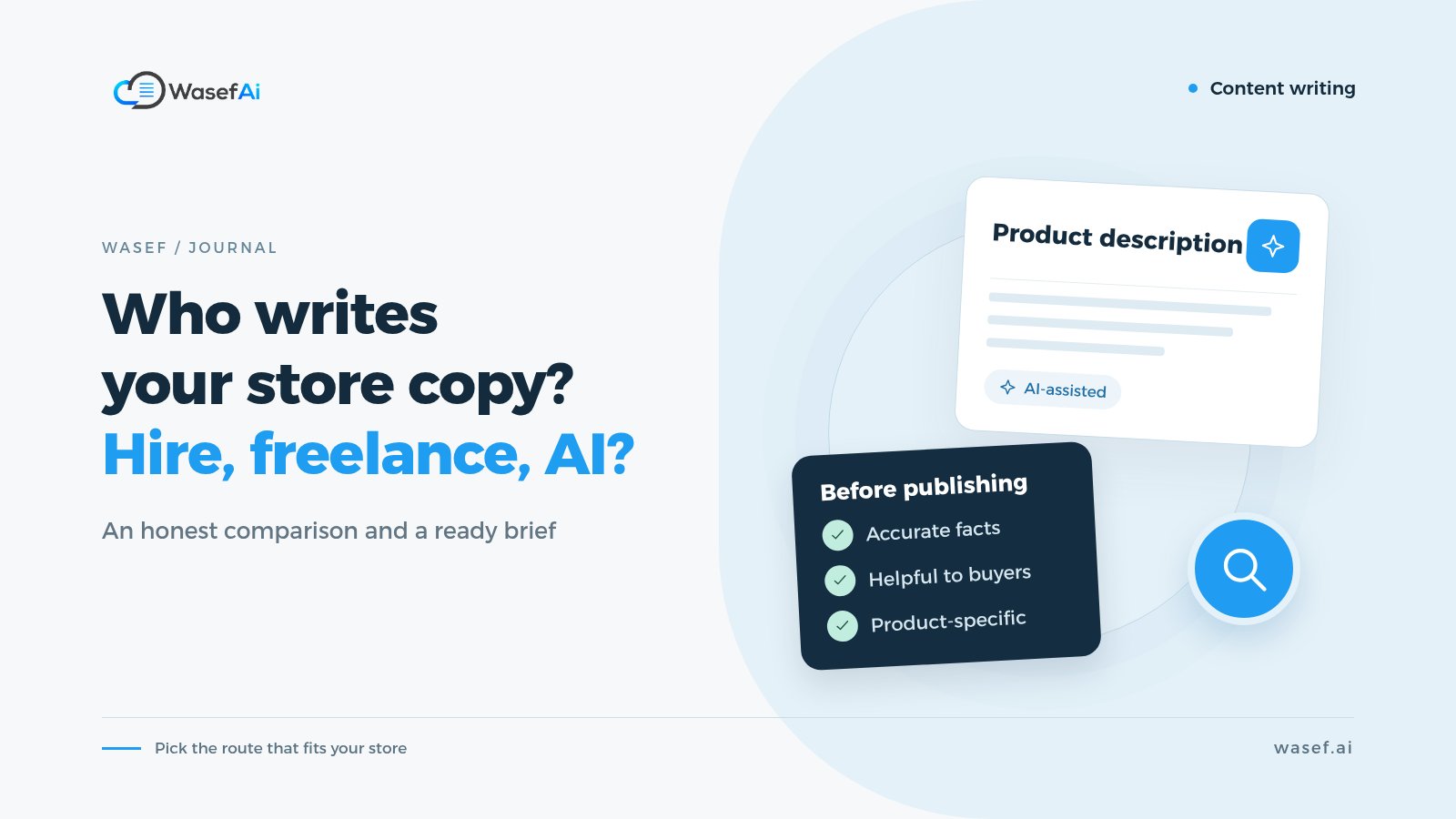
Need a content writer for your store? Which is better: hiring one, using a freelancer, or using an AI tool?
It depends on three things: how many products you have, how often you add new ones, and how much time you have to review. If you add products every week and have other content work too, an employee or a tool inside your store saves you the most time. If you need a limited batch of descriptions or pages like "About us", a freelancer is usually the better fit. And whichever route you take, one thing stays the same: you review before you publish.
Maybe you have 80 products right now, half with descriptions copied from the supplier and half with a single line, and you've finally decided to pay someone to fix them. Before you pay, let's compare the three routes on five points: how you pay, speed, consistency of voice, SEO knowledge, and how much review work lands on you. After that you'll find a ready brief to send any writer, a way to test a writer with one product, and a way to combine AI with human review.
What does your store actually need from a content writer?
Before you choose, define the work. A writer who's great at social posts isn't necessarily great at product descriptions, and the Mostaql blog makes exactly this point. Store content work usually falls into one of these:
- Product descriptions: the recurring work that never ends, especially if you add products often.
- An SEO title and meta description for each product: short texts that appear in Google results, with their own rules. (We explained why SEO matters for your product descriptions.)
- Store pages: About us, policies, FAQs. Written once and updated now and then.
- Offer, season and social copy: short lines that change with every campaign. (You have 70 ready marketing phrases to start from.)
- Blog articles: if your store has a blog.
Write your list and estimate how many pieces you need a month. That number decides which route costs you less.
Option 1: Should you hire an in-house content writer?
An employee knows your products and works with you every day. Here's how that looks on the five points:
- How you pay: a fixed monthly salary, whether or not there's enough work. Salaries vary by experience, city and type of contract, so compare against current job listings instead of relying on a number you heard.
- Speed: available daily and can write a product's description the day it arrives. But their capacity is limited by their working hours.
- Consistency of voice: usually the highest of the three, because they live with the store and learn its voice over time.
- SEO knowledge: depends on the person. In the interview, ask how they pick a keyword for a product and how they write an SEO title.
- Review effort: high in the first weeks, and lower once they learn your products.
It suits you if: your store adds products continuously and you have other content work (social, campaigns, a blog) to fill a full-time role. Watch out: if there isn't enough work, you're paying for idle time.
Option 2: A freelance content writer (Khamsat, Mostaql and others)
The Arabic freelance platforms work differently:
- On Mostaql: you post your writing project and writers start sending you offers, or you invite a specific writer from their profile. You can see their ratings and past work and message them before you choose.
- On Khamsat: a marketplace of small services where you buy a ready-listed service. The platform says prices start from $5, and if the seller is late or doesn't deliver what the service describes, you can cancel the order and get your balance back under its terms.
On the five points:
- How you pay: per project or per service. Prices vary a lot between writers and with text length and number of products, so compare offers yourself. The Mostaql blog warns that a very low budget can drive away qualified writers.
- Speed: choosing and agreeing takes time, and after that speed depends on the writer's commitment and their schedule with other clients.
- Consistency of voice: it changes if you switch writers. A clear brief solves a big part of this.
- SEO knowledge: varies. If you want to show up in search, the Mostaql blog itself advises preferring a writer who knows how to target a keyword, even if they charge more.
- Review effort: higher at the start, because the writer only knows your products from what you send.
It suits you if: you need a limited batch of descriptions, your store pages, or a one-off project.
Option 3: Writing content with AI
There are two kinds here, and the difference shows up in your daily work.
A general chatbot like ChatGPT
- How you pay: some tools are free with limits, others need a subscription.
- Speed: the text appears in seconds, but you copy each product's details in and paste the result into Salla yourself, one product at a time.
- Consistency of voice: it shifts from chat to chat unless you give it the same instructions every time.
- SEO knowledge: it knows the general principles, but it doesn't know what your customers type into search unless you give it the keywords. (Our ready product description prompt shows what to give it.)
- Review effort: high. Google itself says generative AI models don't "retrieve" facts, and asks you to review content for accuracy before publishing, including the title, meta description and image alt text. (Details in Does Google penalize AI-written content?)
An app inside Salla like Wasef
- How you pay: a monthly subscription with credits. For example, Wasef's Lite plan is 49 SAR a month with 2,000 credits.
- Speed: it reads the product data from your store instead of you copying it, and you can select several products and generate for them in one batch.
- Consistency of voice: you write your store's style guidelines once, and it applies them to the texts in every language it writes. The number of brand voices depends on the plan.
- SEO knowledge: along with the description it writes an SEO title and meta description, in Arabic and English.
- Review effort: review is still needed here. The difference is that you review and edit inside the app before publishing, without copying and pasting between two windows.
Quick comparison: the three options side by side
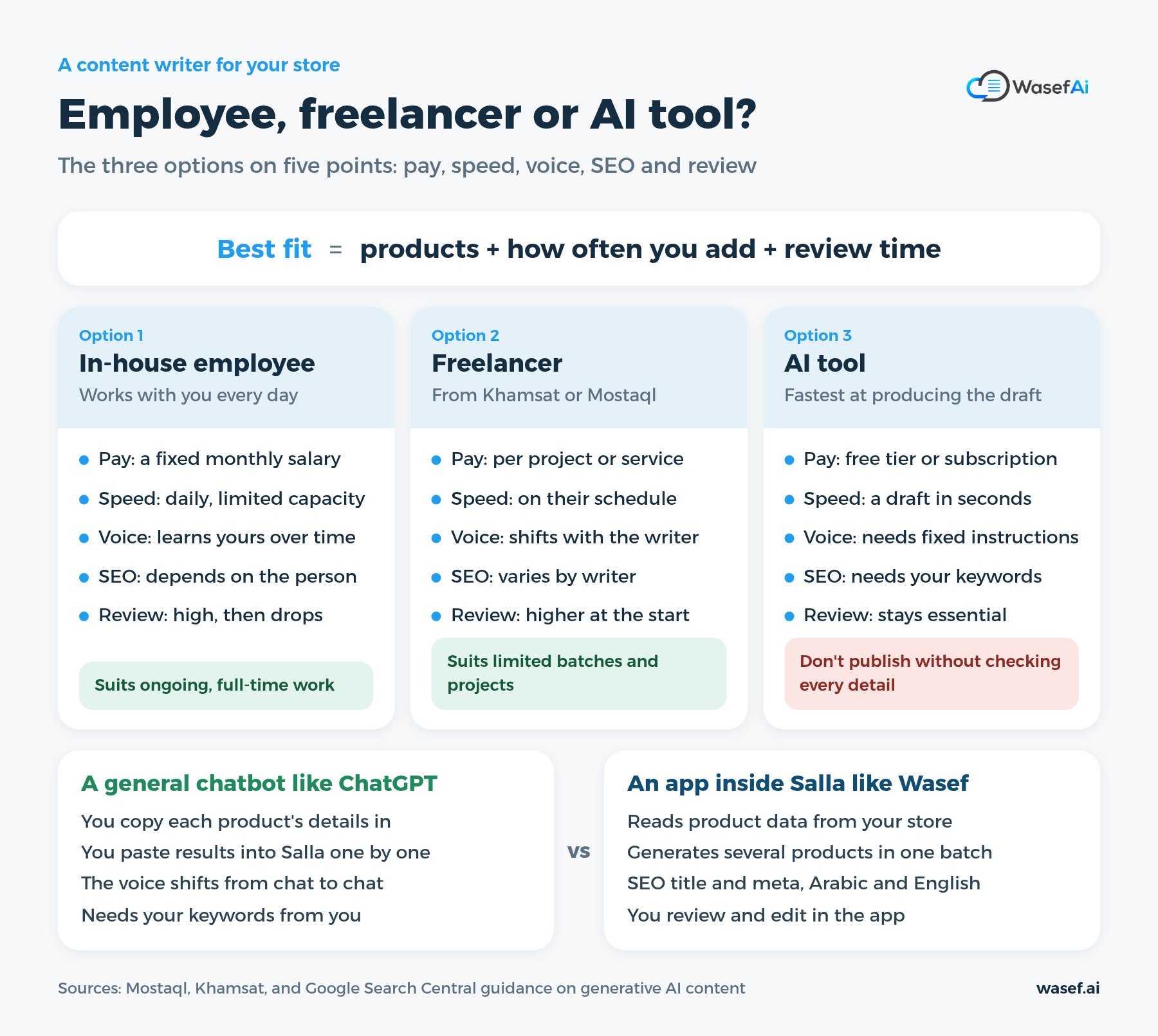
- How you pay: the employee is a fixed monthly salary, the freelancer is per project or service, and an AI tool is free with limits or a subscription.
- Speed: the employee is available daily with limited capacity, the freelancer depends on their schedule, and AI is fastest at producing the draft itself.
- Consistency of voice: the employee learns your voice over time, the freelancer changes when the writer changes, and the tool stays consistent if you keep its instructions fixed.
- SEO knowledge: depends on the person for the employee and freelancer, and the tool needs the keywords from you.
- Review effort: present in all three. It drops with people as they learn your products, and stays essential with AI.
What do you send the writer? A ready brief
Whether you choose an employee, a freelancer or a tool, the quality of the text starts with the quality of what you give. Copy this brief and fill it in:
- About your store: what you sell, to whom, and what sets you apart, in two lines.
- Voice: three words that describe it (for example: friendly, concise, clear), a description from your store that you like, and words you don't want.
- Each product's details: name, specifications, dimensions or capacity, material, what's in the box, how to use it, and photos. If you have the supplier's description, send it as a reference, not as text to copy. (We explained how to turn a supplier description into your store's own.)
- Keyword: for each product or category, if you have one.
- Required format: an approximate length and a fixed order, such as an opening paragraph, then specification bullets, then who it suits. (You can give them a template from ready product description templates.)
- SEO fields: do you want an SEO title and meta description for each product?
- Language: Arabic only, or Arabic and English.
- Don'ts: no invented specifications, no warranty or certification unless it really exists, and no comparisons with other brands.
- Delivery: file format, deadline, and how many revision rounds you're entitled to.
How do you test a writer with one product before handing over your store?
Don't hand 80 products to someone you haven't tried. Run a small test:
- Pick a product with detail: one with specifications, dimensions and uses, not your easiest product.
- Send the same brief to every candidate: and run it through the AI tool too, so you compare on the same basis.
- Judge the result with these questions: Is every detail correct and matching the product? Did it invent anything? Does it answer the customer's questions (size, material, who it suits)? Does the voice sound like your store? Are the SEO fields written naturally?
- Count your review time: a text that needs half an hour of fixing from you isn't cheaper than a pricier one that needs five minutes.
- Scale up in batches: Mostaql's content writers page advises splitting large content into smaller pieces, each with a delivery date, and reviewing drafts early and sending feedback before you accept the work.
The middle route: an AI draft plus human review
Many stores don't need to pick just one route. You can combine them like this:
- Prepare complete product data: this is the step nobody can do for you.
- Let the tool write the draft: the description and SEO fields.
- Have someone who knows the product review it: you, an employee, or a freelancer you hire for "review and edit" instead of "write from scratch".
- Correct and add: check every number against the product, remove any feature that doesn't exist, and add the details only someone who has tried the product knows.
- Review the SEO fields and publish: after publishing, you can check the page for free with the product SEO check.
This way the machine saves drafting time, and a person owns accuracy and voice. It also lines up with what Google asks: it says generating many pages without adding value for users may violate its spam policy on scaled content abuse.
Common mistakes when you pay someone to write your store's content
- Choosing on price alone: the cheapest option can cost you more review time.
- Sending only the product name and expecting an accurate description: the writer, human or tool, only knows what you give them.
- Publishing without review: because "the writer is a pro" or "the tool is smart". You're responsible for the information on your page.
- The same description on similar products: each product deserves a description that says how it differs from the one next to it.
- Keyword stuffing: use the keyword because it serves the meaning, not to repeat it.
If you go the AI route, we've broken down the difference between ChatGPT and an app inside Salla for product descriptions. And if you're considering an agency for all of your SEO, read what to ask an SEO company before you pay.
Where does Wasef fit in this comparison?
Wasef is an app in the Salla App Store that drafts a description for your product from its data, in Arabic and English, with an SEO title and meta description. You review and edit it before publishing. It has a 7-day free trial with no card required, and 24/7 support.
You can try it on the same product you used to test writers and compare for yourself. The steps for your first description are in the tutorial on generating your first product description in Salla, and if you want to learn more about AI SEO for your store, there's a dedicated page.
The bottom line
There's no single right choice for everyone. An employee suits ongoing work, a freelancer suits limited projects, and AI cuts drafting time. What really makes the difference is two things: complete product data you give the writer, and your review before publishing.
Sources
Tags
Before your next campaign, review your product pages with this checklist
Five steps on one page: what to check in your descriptions, how to fill in the SEO fields, and when to add a promotional title. Print it and work through it product by product.
Product page prep checklist
Ready before your next campaign
- Pick the products that will carry the season
- Review every page on mobile
- Fill in the SEO fields in product settings
- Promotional title: honest and temporary
- Spread the work over six weeks