Hire an SEO Company or Do It Yourself? What to Ask Before You Pay
Before you pay an SEO company: what it actually does for your store, what you can do yourself on Salla, the questions to ask before signing, the red flags, and how to measure results in Search Console.
Wasef Team
Do you need an SEO company for your store? Not always. If your store runs on Salla, you can do a large part of the work yourself: product pages, SEO fields and descriptions. An SEO company helps most with technical problems, planning and ongoing follow-up, as long as you choose well. Before you sign, ask clear questions, and walk away from anyone who guarantees you the number 1 spot on Google. Google itself says no one can guarantee that.
Maybe you got a message by email or WhatsApp: "We'll get your store to the top of Google in a month." Or you searched for an SEO company in Saudi Arabia and found that every page calls itself "the best SEO company in Saudi Arabia." So how do you tell them apart? And how do you know whether you need one at all?
This post covers what an SEO company actually does for an online store, what you can do yourself on Salla, the questions to ask before you pay, the red flags that should make you walk away, and how to judge results with real numbers. To be clear: Wasef is not an SEO company and doesn't sell SEO services. It's an app that helps you write your product page content yourself, and we'll be honest about where that's enough and where it isn't.
What does an SEO company do for an online store?
If you're new to the term, start with what SEO means for your online store. Then let's look at what Google itself says. On its page about hiring an SEO, it lists services such as:
- Reviewing your site's content or structure.
- Technical advice on website development, such as hosting, redirects, error pages and use of JavaScript.
- Content development.
- Keyword research.
- SEO training.
- Expertise in specific markets and geographies.
For an online store, this work usually falls into three parts:
- Technical: Can Google reach and index your pages? Are there broken links or duplicate pages? On a hosted platform like Salla, hosting and much of the underlying setup are in the platform's hands, so ask the company what it will actually change in your store when it doesn't control the code.
- Content: The words your customers search for, your product and category pages, and blog posts if you have them.
- Links and reputation: Other sites mentioning and linking to your store. This is where most of the cheating happens, and we'll come back to it below.
What can you do yourself on Salla?
Most of what a small or medium store needs is content work, and nobody knows your content better than you, because you know your products and your customers' questions:
- Product descriptions: A description that answers the customer's questions in their own words, not generic copy. We explain why this matters in why SEO matters for product descriptions.
- SEO fields: The page title, description and URL in each product's settings. Here's a guide to every field: SEO fields in Salla products.
- Category and brand pages: They have the same fields, and they're often the pages that show up for broader searches.
- Showing your products in the Shopping tab: You can connect your store yourself. The steps are in our Google Merchant Center guide for Salla stores.
- Tracking your numbers in Search Console: A free tool from Google. We explain what to watch below.
For the full picture, from settings to sales, see our guide to SEO for Salla stores.
When does hiring an SEO company make sense?
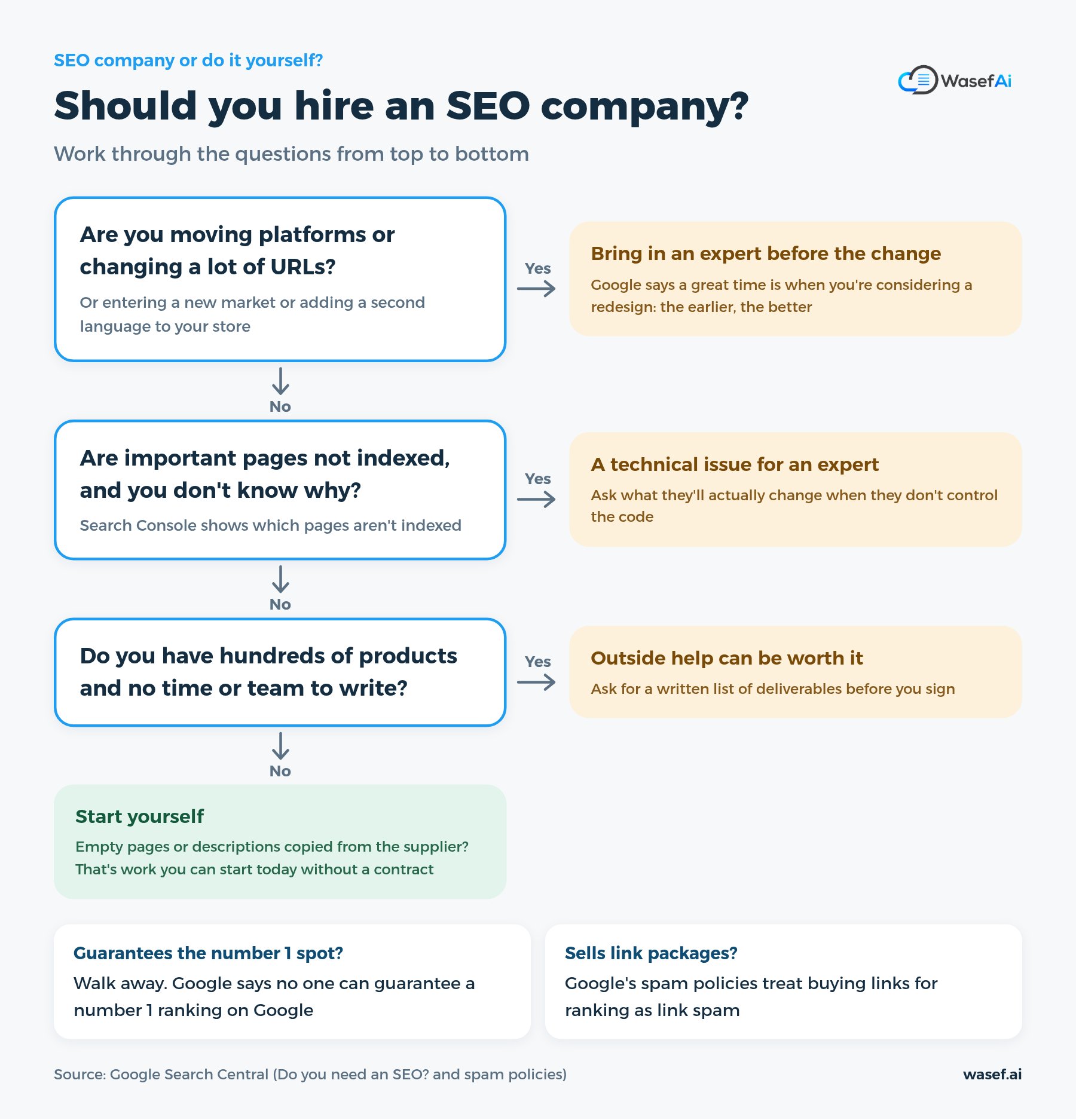
Google says a great time to hire an SEO is when you're considering a site redesign (the earlier, the better), or planning to launch a new site. For a Salla store, these are situations where outside help can be worth it:
- You're moving your store from one platform to another, or changing a lot of URLs.
- Search Console shows important pages that aren't being indexed, and you can't work out why.
- You have hundreds of products and no time or team to write for them.
- You want to enter a new market or add a second language to your store.
But if your problem is that product pages are empty or the descriptions are copied from the supplier, that's work you can start today without a contract.
What should you ask an SEO company before you sign?
These questions come from Google's own page, with a short note on each:
- Can you show me examples of your previous work and share some success stories? Ask for online stores specifically, not company websites.
- Do you follow the Google Search Essentials? If they don't know what those are, that tells you something.
- What kind of results do you expect to see, and in what timeframe? And how will you measure them?
- What's your experience in my industry? A perfume store is not a car parts store.
- What's your experience in my country or city? Arabic search in Saudi Arabia has its own vocabulary.
- What's your experience developing international sites? This matters if your store is in Arabic and English or sells across the Gulf.
- How long have you been in business?
- Will you share with me all the changes you make to my site?
And three questions of our own for stores: What exactly is included each month, in writing? Who owns the content and accounts if we stop working together? And what permissions do you need in the Salla dashboard?
What red flags should make you walk away?
- Guaranteed number 1 rankings: Google says it plainly: no one can guarantee a number 1 ranking on Google.
- A "special relationship" with Google or "priority submit": Google says it never accepts money to include or rank sites in its search results.
- Link packages: Offers like "X backlinks for Y riyals." Google's spam policies treat buying or selling links for ranking purposes as link spam, along with excessive link exchanges ("link to me and I'll link to you"). Google also advises avoiding SEOs who promote link schemes or submitting your site to thousands of search engines.
- Asking you to link to them from your store: Google says you should never have to link to an SEO.
- Secrecy: If they can't clearly explain what they intend to do, Google advises caution.
- Asking for write access to Search Console on day one: Google advises granting only read access at the audit stage.
- Unsolicited messages: Google advises being wary of firms that contact you by email out of the blue.
- "We'll run ads and you'll rise in the free results": Google says advertising with Google won't have any effect on your site's presence in its search results.
- No clear reporting: If you don't know at the end of each month what was done and what changed in the numbers, how can you decide whether to continue?
Watch out for misleading content too: Google says deceptive or misleading content created by an SEO can lead to your site being removed from its index. If the company writes content for you with AI, that isn't a problem in itself; what matters is quality and usefulness. We covered this in does Google penalize AI-written content?
How do SEO companies price their work?
We won't give numbers here, because prices vary a lot with store size and scope, and we didn't find a reliable source to base them on. The common pricing models are usually one of these:
- Monthly retainer: Ongoing monthly work, such as content, monitoring and reports.
- Fixed-price project: Work with a clear start and end, such as a store audit, setting up a new store, or a migration.
- Hourly consulting: You bring your questions, an expert reviews them with you, and you or your team do the work.
- Content per piece: A price per article or per product description.
Whatever the model, ask for a written list of deliverables, compare offers by the work that will be done rather than price alone, and be careful with long contracts that have no review point along the way.
How do you judge whether the work paid off?
Your main tool is the Performance report in Google Search Console. It gives you four numbers:
- Clicks: How many times someone clicked through to your store from Google results.
- Impressions: How many times your store appeared in results.
- CTR: Clicks divided by impressions.
- Average position: The average position of your store's top result.
You can break the numbers down by search query, page, country or device. To get the most out of them:
- Record your numbers before the company starts. Without a starting point you can't compare.
- Watch your important product and category pages, not just the home page.
- Connect the numbers to sales from your store reports. Clicks without orders aren't enough.
- Don't judge after a week. Agree with the company up front on the expected results and timeframe, as Google suggests.
- Don't hang everything on one keyword's ranking. One keyword doesn't give you the full picture; what matters is clicks and orders across all of them.
Where do you start today?
- Check one product page with the free SEO check for Salla product pages: paste the product link, and it tells you what's missing on the page and how to fix it.
- Fix your 10 most important products: the description and the SEO fields.
- Connect Search Console and record your numbers.
- Then decide: if the problem is bigger than content, bring in a company, armed with the questions above.
If writing is what you're missing more than technical work, see our comparison of hiring a writer, a freelancer or an AI tool.
What if you decide to write the content yourself?
Wasef is an app on the Salla App Store that drafts a description for your product from its data, in Arabic and English, along with an SEO title and meta description. You review and edit the draft before publishing. There's a 7-day free trial, no card required. It won't replace an expert if your problem is technical, but it saves you time on product page work. To learn more about SEO and AI, see AI SEO for online stores.
Sources
Google Search Central: Do you need an SEO?
Google Search Central: Spam policies for Google web search
Google Search Console Help: Performance report (Search results)
Tags
Before your next campaign, review your product pages with this checklist
Five steps on one page: what to check in your descriptions, how to fill in the SEO fields, and when to add a promotional title. Print it and work through it product by product.
Product page prep checklist
Ready before your next campaign
- Pick the products that will carry the season
- Review every page on mobile
- Fill in the SEO fields in product settings
- Promotional title: honest and temporary
- Spread the work over six weeks