Why SEO Matters for Product Descriptions: Help the Right Customer Find and Understand Your Product
A product description is more than a few lines under a photo. Learn how SEO product descriptions help you reach the right customer and write copy that convinces them, with examples and steps you can apply in your store.
Wasef Team
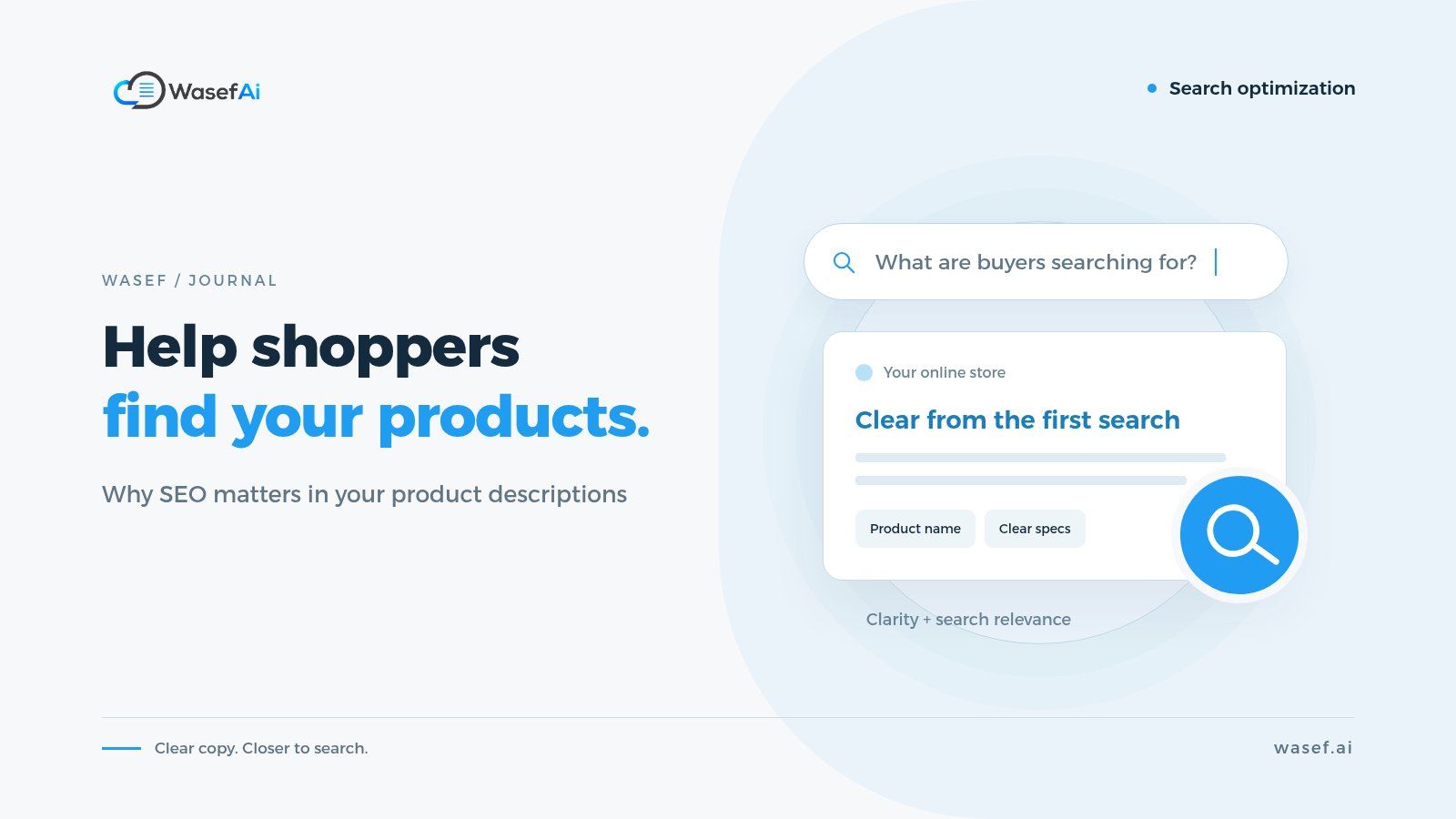
Picture this: you've worked hard on your store, picked great products and photographed them neatly. Then under every product you write: "High quality, elegant design, great price." It sounds nice, but what has the customer actually learned about the product? And what is there to help a search engine understand when to show your page? That's where SEO product descriptions come in. Not so you write for search engines instead of people, but so the right information reaches the right person, and your product page is useful from the very first visit.
What is product description SEO, and why does it matter?
SEO stands for search engine optimization, and in simple terms it means making your content easier to discover and understand (if you want the full basics, start with what SEO is and how it works). On a product page, the description gives context that a short product name can't provide on its own: what the product is, who it suits, how it's used and which specs matter. When that information is clear and written in your customer's language, the page is better able to answer their search. But let's agree on one thing up front: improving your product description SEO doesn't guarantee the top spot, and it won't make up for a problem that stops the page from being indexed or a frustrating checkout.
Google's SEO Starter Guide describes SEO as helping search engines understand your content, and helping people find your site and decide whether to visit it. So it isn't a trick or a secret word. You're organizing the information you already have and presenting it clearly. The more closely your description is tied to the real product and to what the buyer needs, the better your foundation, compared with a generic paragraph you could paste under a perfume, a bag or a coffee machine without changing a word.
It's not about more visitors, it's about the right visitor
There's a difference between someone searching for "bag" and someone searching for "15-inch laptop bag for work". The second person has spelled out their need, and your product description can answer them if the specs genuinely match. When you mention the size, the type of use, the material and how it closes, you're not adding random details; you're helping the customer tell whether they've found the right option. Specific phrases deserve attention because they express a clearer need, but that doesn't automatically mean less competition or guaranteed sales.
Start with the question behind the search. Is the customer looking for a gift? Does size matter because they travel a lot? Do they need something compatible with a particular device? That's search intent, and you don't need jargon to work with it. Go through customer questions and the messages you receive, and if you have data in Google Search Console, look at the queries your product pages appeared for. Use them to understand your audience's language, not to cram every phrase into the description whether or not it fits the product.
A good description helps the customer once they land on the page
Arriving from Google is the start of the journey, not the end. A customer on your product page usually has questions before paying: Will the size fit? What's in the box? How do I clean it? Does it need an extra part to work? A clear description cuts down the guesswork and helps them make an informed decision. That can support the purchase and reduce questions caused by missing information, but the outcome also depends on price, trust in your store, shipping, your returns policy and how easy it is to pay. Don't credit every change in sales to the description alone.
Here's an important point: your description isn't supposed to talk everyone into buying no matter what. Sometimes the best service you can offer is making clear who the product isn't for. If the bag can't fit devices above a certain size, say so plainly. If the mug needs hand washing, don't hide that under promotional copy. Realistic expectations matter more than a quick order that ends in disappointment. Write like a knowledgeable shop assistant calmly explaining things to a customer, not like an ad repeating that everything is the best.
How to write product descriptions for SEO: use your customers' words, not repetition
Choosing keywords starts with an accurate product name, followed by the attributes that genuinely set it apart. For example, "stainless steel insulated coffee mug, 350 ml" is clearer than "premium special mug". Use the main phrase naturally in the product title and the opening of the description, then explain the rest of the details without forcing yourself to repeat it. There's no magic keyword density to chase. If you read the text aloud and it sounds odd or repetitive, it probably needs simplifying.
Also watch the gap between everyday language and technical terms. Your audience might say "mug" rather than "cup" (in Arabic, many shoppers say «مج» rather than «كوب»), but you don't need to pile every synonym into one sentence. Pick the wording closest to how they talk, and mention the alternative term if it helps understanding. For tech products, keep model numbers, compatibility and units exact. Don't add a famous brand or a trending device name just to attract searches if it has no real connection to the product. Irrelevant traffic won't solve your store's problems.
Turn specs into benefits, without inventing promises
A spec tells the customer what's there; a benefit explains why it matters to them. "Adjustable strap" is a spec; "you can set the strap length to suit how you carry it" is the benefit that goes with it. Combine the two instead of settling for phrases like "exceptional comfort" and "an unmatched experience". Every feature you write needs a basis in the product data. Don't conclude the fabric is waterproof from how it looks, and don't promise it keeps drinks hot for a set number of hours without reliable information or proper testing to back that up.
A practical example: same product, clearer description
Let's use a hypothetical bag. All the specs here are for illustration only and aren't real product data. The weak description says: "An amazing bag of excellent quality, suitable for everyone, order now." The problem isn't just that it's short; it's that it doesn't answer a single important question. The customer doesn't know which device size fits, how to organize their things, or what it's made of. Even "suitable for everyone" is far too broad, because a university student's needs are different from those of someone who travels with lots of devices and accessories.
An improved description could be: "A laptop bag for work with a padded compartment measuring 36 × 25 × 2 cm inside. Compare your device's dimensions with this space before ordering, because screen size alone isn't enough. The front pocket helps you keep your charger and small items organized, and the adjustable strap lets you set how you carry it. Made of polyester; clean with a damp cloth according to the care instructions. This bag isn't designed to protect your device from being submerged in water." Now we have a useful description instead of a string of promotional adjectives.
Why isn't copying the supplier's description the best option?
The supplier's description is a good source for specs, but it doesn't necessarily answer your audience's questions. And if you just copy it like dozens of other stores, what extra value does your page offer? It's better to keep the accurate facts and add your own explanation of use, sizing and the differences between options (see how to rewrite supplier product descriptions). Duplicate text doesn't automatically mean a Google penalty, so don't build your work on that idea. The practical reason to write your own description is to offer real usefulness and differentiation, not to swap words for synonyms so the text merely looks different.
Your product description isn't your meta description
The product description lives on the page and explains the details. The meta description is a summary Google may use for the snippet in search results, or it may choose other text from the page instead, depending on the search. Write an honest, specific summary that encourages the right person to visit, and don't treat it as a place to stuff keywords. The page title also needs to be clear and distinct. Remember that improving how your result looks is one thing and guaranteeing a higher ranking is another; don't treat the meta description as a button that lifts your ranking directly. If you sell on Salla, here's what to write in Salla's product SEO fields.
There's also a complementary technical layer called product structured data. It helps Google understand details such as price, availability and reviews, and may allow them to appear in a richer way in search results. But it doesn't replace the product description, and adding it doesn't guarantee a rich result. What matters is that the data is accurate and matches the visible content, and that you don't add fake reviews or discounts. If you use an e-commerce platform, check what it already provides before asking for any technical change, so you don't duplicate data unnecessarily.
How many words does a product description need?
The short answer: as many as the customer needs to understand the product and decide. Google states that it has no preferred word count. A simple product might need just a short description with clear specs, while a complex device needs a longer explanation of compatibility, use and care. Don't try to turn every product page into an article, and don't cut so much that information gets lost. Let the first paragraph cover the most important benefit, then break the details into short headings and bullet points that are easy to scan, especially for customers browsing on their phones.
Use AI as an assistant, not as a source of specs
If you have lots of products, AI can help you organize drafts and keep a consistent writing style. Give it verified information about the product and the audience, and ask it not to invent features, certifications or usage results. Then review every sentence yourself. The problem isn't the tool; it's publishing generic or inaccurate text at scale without adding value. Google's guidance focuses on how helpful and reliable content is, and warns against producing content whose main purpose is to manipulate rankings. Speed is useful, but accuracy comes first.
How do you know the SEO for your online store is paying off?
Start with a small group of important products and note the date you changed each description. Track their impressions, clicks and search queries in Search Console, then watch what happens inside the store, such as add-to-cart and purchases, if tracking is set up correctly. Don't judge after two days, and don't treat any increase as conclusive proof of the text's impact. Season, price, ads and stock availability can all change the results. A useful comparison takes these conditions into account and separates better reach from a better decision-making experience. For the bigger picture, from category pages to Search Console, see our Salla SEO guide.
Before you publish, ask yourself these questions
Is the product name clear? Does the description explain who it's for and when it's used? Are sizes, materials and compatibility written accurately? Have you linked specs to understandable benefits without exaggerating? Have you answered the question customers ask most often? And does the text sound natural when you read it aloud? Also check that the photos match the product, and that price, availability and shipping information are clear in their places. You don't need to squeeze everything into one paragraph; what matters is that the product page as a whole gives a complete, easy-to-find answer.
In the end, SEO for product descriptions isn't a game of repeating keywords. It's understanding your customer and explaining your product honestly in a way that helps both people and search engines. Start with one product, delete the copy that could apply to anything, and replace it with information that helps someone who's genuinely thinking about buying it. Then repeat and watch the results calmly. A great description doesn't need to be fancy or long for no reason; it needs to be clear, accurate and leave the customer thinking: now I know whether this product is right for me.
Sources and further reading
The search engine guidance in this article is based on the following official Google sources. The examples and sample wording are for illustration and aren't the results of an actual test on a specific store.
Google's SEO Starter Guide: understanding content, titles, snippets and avoiding keyword stuffing.
Tags
Before your next campaign, review your product pages with this checklist
Five steps on one page: what to check in your descriptions, how to fill in the SEO fields, and when to add a promotional title. Print it and work through it product by product.
Product page prep checklist
Ready before your next campaign
- Pick the products that will carry the season
- Review every page on mobile
- Fill in the SEO fields in product settings
- Promotional title: honest and temporary
- Spread the work over six weeks