Does Google Penalise AI-Written Content? What Google Actually Says
Google doesn't penalise text because it was written with AI, but it has clear cases it treats as violations. What Google itself says, whether you need an AI detector, and a checklist before you publish any description.
Wasef Team
You want to use AI to write your product descriptions, but one question stops you: "Will Google detect that the text was written by AI and penalise my store?" You may also have heard that you need to run every text through an AI detector before publishing.
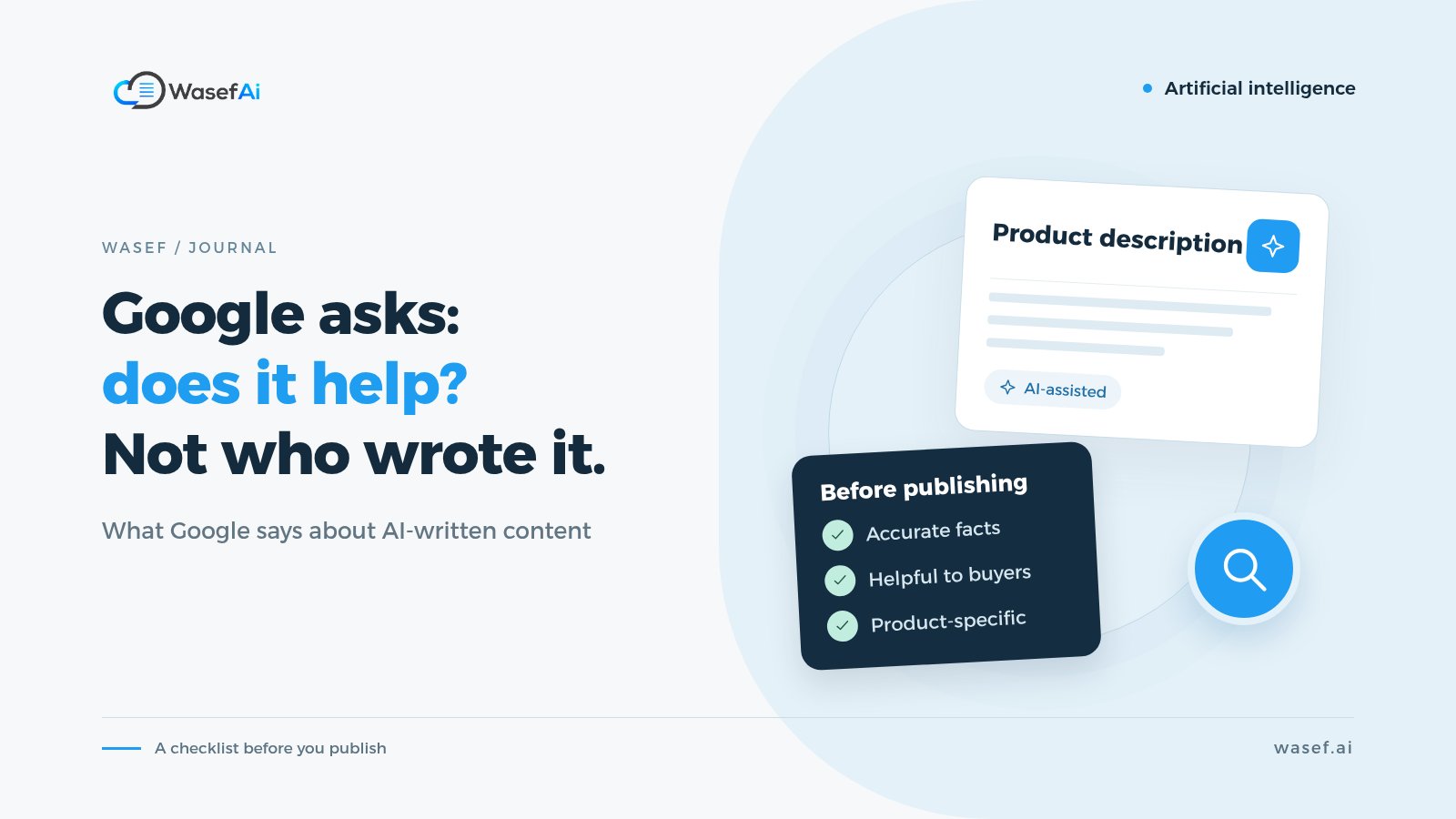
The short answer: Google doesn't penalise text because it was written with AI. Google cares about the quality of content and how useful it is to the reader, not how it was written. But there are clear cases Google treats as violations, and those are the ones you need to know.
Let's look at what Google itself says, not what people say about it.
Does Google penalise AI-written content?
In February 2023 Google published an official statement on AI-generated content, and it was clear. Here are the main points:
- Google rewards good content however it's produced. Its ranking systems look for original, helpful content that shows experience, expertise, authoritativeness and trustworthiness (what it calls E-E-A-T).
- Appropriate use of AI isn't against its guidelines. The violation is using it with the primary purpose of manipulating search rankings.
- AI doesn't give content any special advantage. In Google's words: "It's just content." If it's useful and accurate, it might do well in Search. If it isn't, it might not.
So the right question isn't "Was this written by a person or by AI?" The right question is: "Does this description help the customer reading it?"
So what does Google treat as a violation?
Google has a policy called "scaled content abuse". It's when many pages are created with the primary purpose of manipulating search rankings rather than helping people. Among the examples Google gives:
- Using AI tools to generate many pages without adding value for readers.
- Copying content from other sites and transforming it automatically, such as swapping words for synonyms or translating it, without adding anything useful.
- Pages full of keywords that make little sense to a reader.
Notice that the problem in every example is the lack of value, not the use of AI. The same applies to text a person wrote and copied across a hundred products.
What does this look like in an online store?
Applied to your store, these are the kinds of things that move you closer to the problem:
- A hundred products with almost the same description, where the only difference is the product name.
- Generic descriptions that could fit any product in the world: "High quality and an elegant design to suit every taste."
- Text stuffed with the same search phrase repeated ten times.
- A supplier's description copied word for word, while the same text appears on dozens of other stores. (We've explained how to rewrite a supplier's description without losing the specs.)
On the other hand, a description that gives the product's real dimensions, material, what's in the box and who it suits is helpful content, even if AI helped you word it.
What does Google ask of you if you use AI?
Google has a guidance page specifically about using AI-generated content on your site, and it updated the accuracy section in October 2026. The key point: AI models don't "retrieve" facts. They predict the most likely words based on their training data, so they can produce wrong information with confidence. That's why Google says it's critical to manually fact-check and review content before publishing.
And that review isn't limited to the main text. Google specifically names:
- The page title.
- The meta description.
- Structured data.
- Image alt text.
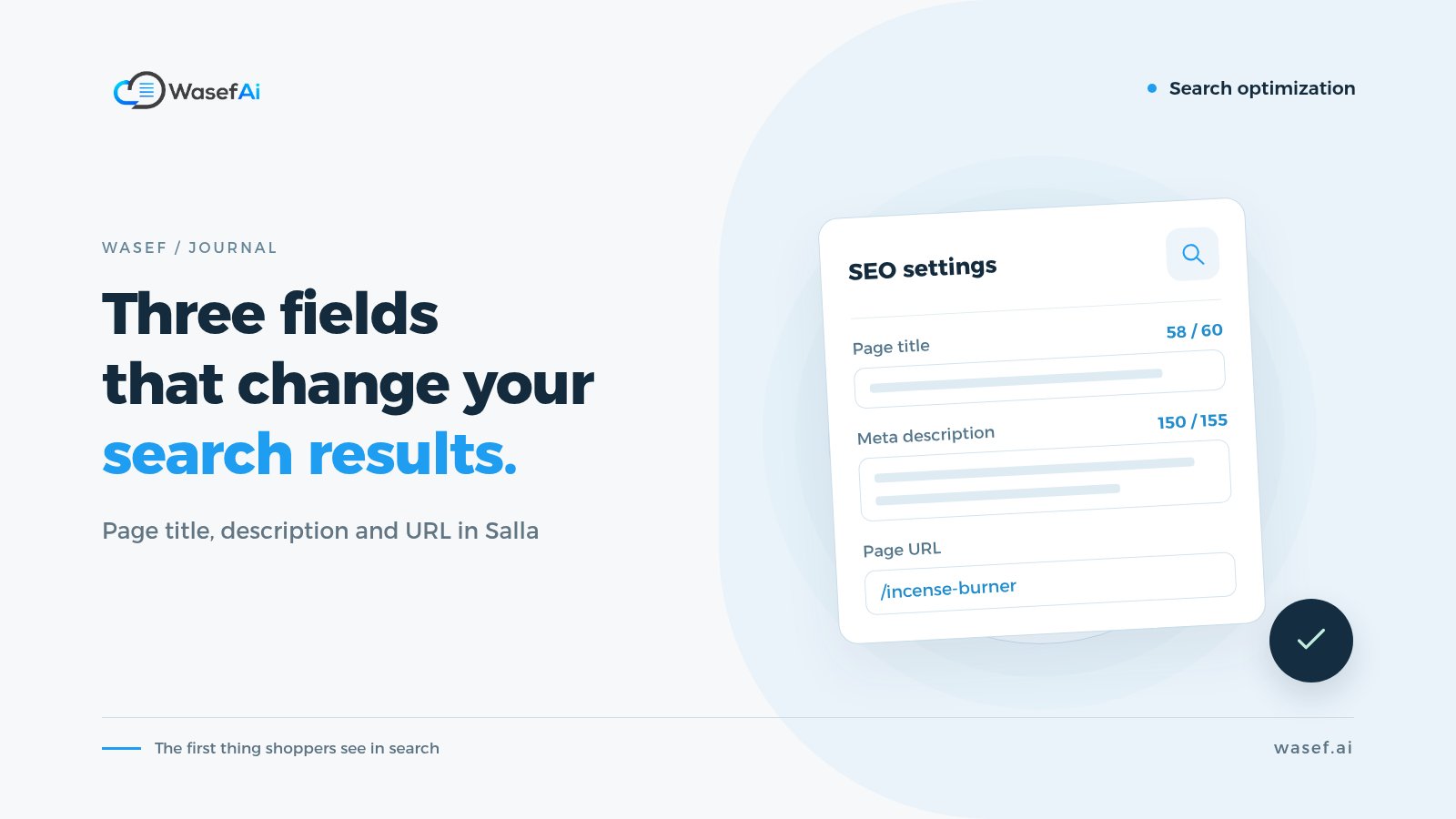
So the SEO fields on your products are part of the review too. (Our guide to the SEO fields in Salla products explains what to write in each one.)
Do I need an AI detector before I publish?
Many store owners look for an "AI detector" to make sure their text "won't get caught". But this step usually doesn't help, for two reasons:
- Google doesn't judge content on whether it was written with AI. It judges it on quality and usefulness. So passing a detector doesn't mean the text is good, and failing one doesn't mean it will be penalised.
- Detection tools aren't accurate. Even OpenAI, the company behind ChatGPT, launched a tool to detect AI-written text in January 2023, then shut it down in July of the same year because of its low accuracy.
Instead of spending your time trying to "beat" a detector, spend it making sure the description is accurate and useful. That's what matters to the customer, and it's what matters to Google.
Do I need to say the content was written with AI?
Google suggests explaining how content was produced when readers would reasonably ask "How was this created?". On product pages, customers usually care more about the accuracy of the information than how it was written.
But there's an important exception: if you upload your products to Google Merchant Center to appear in Google Shopping, Google requires titles and descriptions written with generative AI to be submitted in dedicated attributes and labelled as AI-generated. Images generated with AI must also carry metadata saying so. Check the source below if this applies to your store.
A checklist before you publish any AI-written description
- Every number is correct: dimensions, weights, capacity, model. Check them against the product or the supplier's data.
- No invented features: no water resistance, warranty or certification unless it really exists.
- The description is about this product specifically: if you could put it on another product without changes, it's too generic.
- It answers the customer's questions: size, material, what's in the box, who it suits.
- The keyword reads naturally: it's there because it serves the meaning, not stuffed in.
- SEO fields are reviewed: the title, meta description and image alt text.
- It reads well on a phone: short paragraphs, with the most important information easy to find.
The bottom line
Google doesn't ask who wrote the description; it asks whether the description helps. Use AI to save time on wording, and keep responsibility for accuracy with you. Most importantly, give it accurate data from the start. There's a ready-made prompt for product descriptions you can copy and fill in with your product's details.
That's exactly what Wasef is built on: it drafts the description and SEO fields from each product's data in your Salla store, without inventing specs that aren't there, and you review and edit them before you publish.
Sources
- Google Search Central Blog: Google Search's guidance about AI-generated content (February 2023)
- Google Search Central: guidance on using generative AI content on your website
- Google Search Central: spam policies (scaled content abuse)
- Google Merchant Center Help: AI-generated content
- Search Engine Journal: OpenAI shuts down its AI text detector over low accuracy
Tags
Before your next campaign, review your product pages with this checklist
Five steps on one page: what to check in your descriptions, how to fill in the SEO fields, and when to add a promotional title. Print it and work through it product by product.
Product page prep checklist
Ready before your next campaign
- Pick the products that will carry the season
- Review every page on mobile
- Fill in the SEO fields in product settings
- Promotional title: honest and temporary
- Spread the work over six weeks