AI Product Description Prompts: What to Give the AI for Copy You Can Use
A good AI product description starts with clear facts, not "write a professional description". Learn how to prepare your product data, use a copy-paste prompt template, and review the draft before you publish.
Wasef Team
You ask an AI tool to "write a professional description for a bag," and it comes back full of elegance, quality and comfort. You read it and think: it's tidy, but it could sit on any bag in the world. Most of the time, the problem with an AI product description starts with the request itself. You gave the tool the product name and left it to guess everything else. Let's fix the way you ask, so you get a useful draft you can review and publish, not text you have to rewrite from scratch.
Start with a fact sheet, not "write me a description that sells"
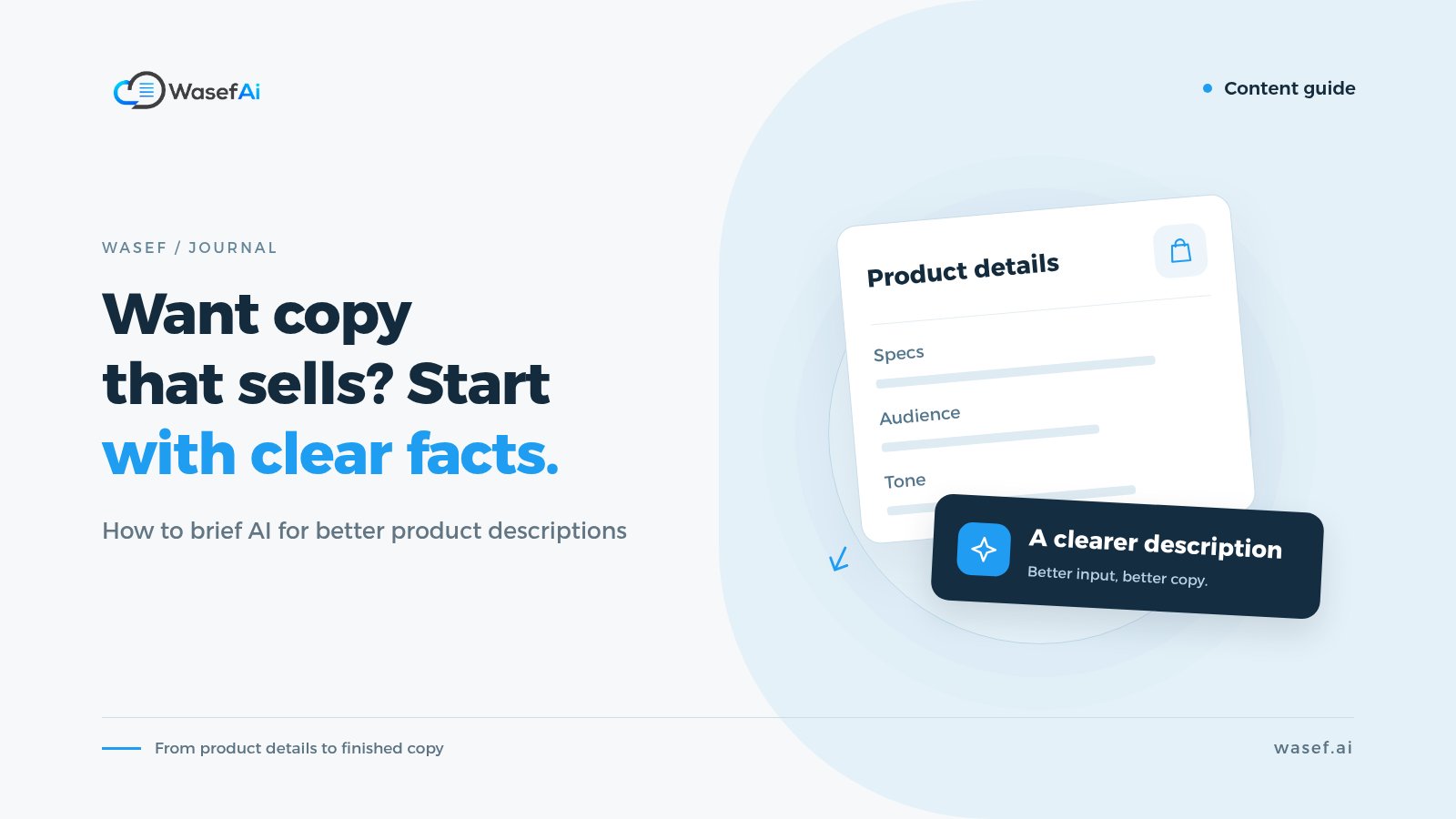
Imagine handing the job to a new employee. What would they need to know? The product name and model, material, dimensions, available options, what's in the box, and care instructions. Collect this from a reliable source, such as the product manual or the supplier's data once you've checked it (here's how to sort supplier descriptions into what to keep and what to drop). If specs differ between sizes or models, separate them clearly. Don't give the tool data for different products and ask for one description.
Add the customer's main question: do they care about size? Easy cleaning? Whether it works with their device? You can draw on the questions you get again and again, without sending customer names, phone numbers or full chat logs. The goal is to understand the need, not to share personal data that has nothing to do with the description.
Separate facts from the angle you want to write from
"The strap is adjustable" is a fact if the product data confirms it. "For people who carry their things to work" is a suggested writing angle. "Keeps your shoulder comfortable all day" is a performance claim that needs evidence; an adjustable strap alone doesn't prove it. Tell the tool that the target audience helps it choose how to explain things, but it is not permission to add features.
State missing information plainly: "water resistance not confirmed" or "warranty period not in the data." Ask for the gaps to go in separate notes for you, not turned into promises in the copy. And if the information matters for the buying decision, like whether a charger works with a specific device, verify it before you publish instead of skipping it.
A copy-paste product description prompt template
Use the text below as a single prompt (it works in ChatGPT or any similar AI product description generator) and replace everything in brackets with your own details. If you don't have a piece of information, write "not available" instead of leaving room for guessing. Set the language line to what your store needs: for a Salla store selling to Saudi shoppers, that might be "Arabic, clear, with a light Saudi touch"; for an English page, "English, plain and friendly." If you would rather start from a finished structure for your category, see these product description templates by category.
Task: Write a draft description for a product page in an online store. Language: [e.g. Arabic, clear, with a light Saudi touch / plain, friendly English]. Speak to the customer directly, and avoid hype and generic phrases like "the best ever."
Verified product data: Product name and model: [write here] Material, dimensions and capacity: [write here, with units] Confirmed features: [write here] Options and how they differ: [write here] What's in the box: [write here] Compatibility, limitations and care instructions: [write here] Information not available: [write here]
Writing context: Target customer and intended use: [write here] Most important question before buying: [write here] Product name or search phrase customers use: [write here if known and accurate for this product]
Accuracy rules: Rely only on the verified data above. Do not infer water resistance, compatibility, certifications, warranty length or usage results. Tie every benefit to a spec that directly supports it. Do not add discounts, low-stock claims or shipping promises. If the data is contradictory, ask me before writing the final version.
Required output: a clear title, then a short intro, then bullet points for the specs and supported benefits, then limitations and care where available. Use the search phrase naturally without forced repetition. After the description, add a separate section titled "Review notes — do not publish" listing missing information and anything that needs confirming. Keep the length proportional to the information; don't pad the text.
Example: how does the result change when the prompt is clear?
This is a hypothetical example for illustration, not real product data or the result of testing a specific tool. We have a cable organizer pouch: polyester, external dimensions 20 × 12 × 5 cm, two mesh pockets, zip closure. It's sold without accessories, and the care instructions allow wiping it with a damp cloth. Water resistance is not confirmed.
The vague prompt: "Write a marketing description for a cable pouch." A weak draft might read: "A luxury pouch that protects your devices from water and shocks and holds all your accessories wherever you go." The problem isn't just the style. Nothing supports water or shock protection, and "all your accessories" ignores the fact that accessories come in different sizes.
A more accurate version based on the fact sheet: "Keep your small cables in one place instead of scattered around your bag. A polyester organizer pouch with two mesh pockets to help you separate small items, and a zip closure. External dimensions are 20 × 12 × 5 cm; check your items and the internal space before relying on it for a specific piece. Sold without cables or accessories. Wipe clean with a damp cloth."
Notice we didn't turn the external dimensions into a promise of equal internal space, and we didn't add water protection. In the review notes we'd write: "Check the internal dimensions if you plan to mention fitting a specific charger." That note is for you, not part of the published description.
Don't like the draft? Make your follow-up specific
Instead of "make it better," say: "Remove the generic intro and open with the problem of tangled cables. Cut the repeated benefits, and keep the dimensions and box contents exactly as they are. Don't add any new information." If the tone is too formal, ask for simpler sentences without changing the facts. Specific direction gets the draft closer to what you need, but it doesn't remove the need to review it.
Before you publish: check facts first, style second
- Match every number, unit and model against the source.
- For every benefit, ask: which spec proves it?
- Make sure the description matches the option shown, not another size or version.
- Review limitations, compatibility, care and box contents.
- Delete hype, review notes and any brackets you didn't fill in.
- Read the text on your phone: is the most important answer clear without digging?
Don't treat asking the tool "is this information correct?" as an independent check; it can repeat the same mistake confidently. Go back to the product manual or another reliable source, and review health and safety claims with extra care. Polished wording doesn't mean the information is proven.
And if you're wondering whether Google will penalise your store because a description was written with AI: the short answer is no, as long as it's accurate and useful to the customer. We cover what Google actually says in Does Google penalise AI-written content?
How to write product descriptions with AI: start with one product
Pick a product you know well, prepare its fact sheet, and try the template. Notice what you had to correct: was data missing? Was the tone overblown? Were options mixed up? Adjust the fact sheet and the rules before using them for the rest of your products. The goal isn't to publish as many descriptions as fast as possible; it's to cut down the writing work while keeping responsibility for accuracy. AI arranges the words, and you make sure they match the product your customer will receive. If you use Wasef on Salla, this walkthrough shows how to write your first description with Wasef and publish it to Salla.
Tags
Before your next campaign, review your product pages with this checklist
Five steps on one page: what to check in your descriptions, how to fill in the SEO fields, and when to add a promotional title. Print it and work through it product by product.
Product page prep checklist
Ready before your next campaign
- Pick the products that will carry the season
- Review every page on mobile
- Fill in the SEO fields in product settings
- Promotional title: honest and temporary
- Spread the work over six weeks