How to Write a Specialty Coffee Description: Tasting Notes, Terms and a Template
What specialty coffee is, what the terms on your product page mean, and a ready-made coffee description template for Salla with two illustrative examples and SEO tips.
Wasef Team
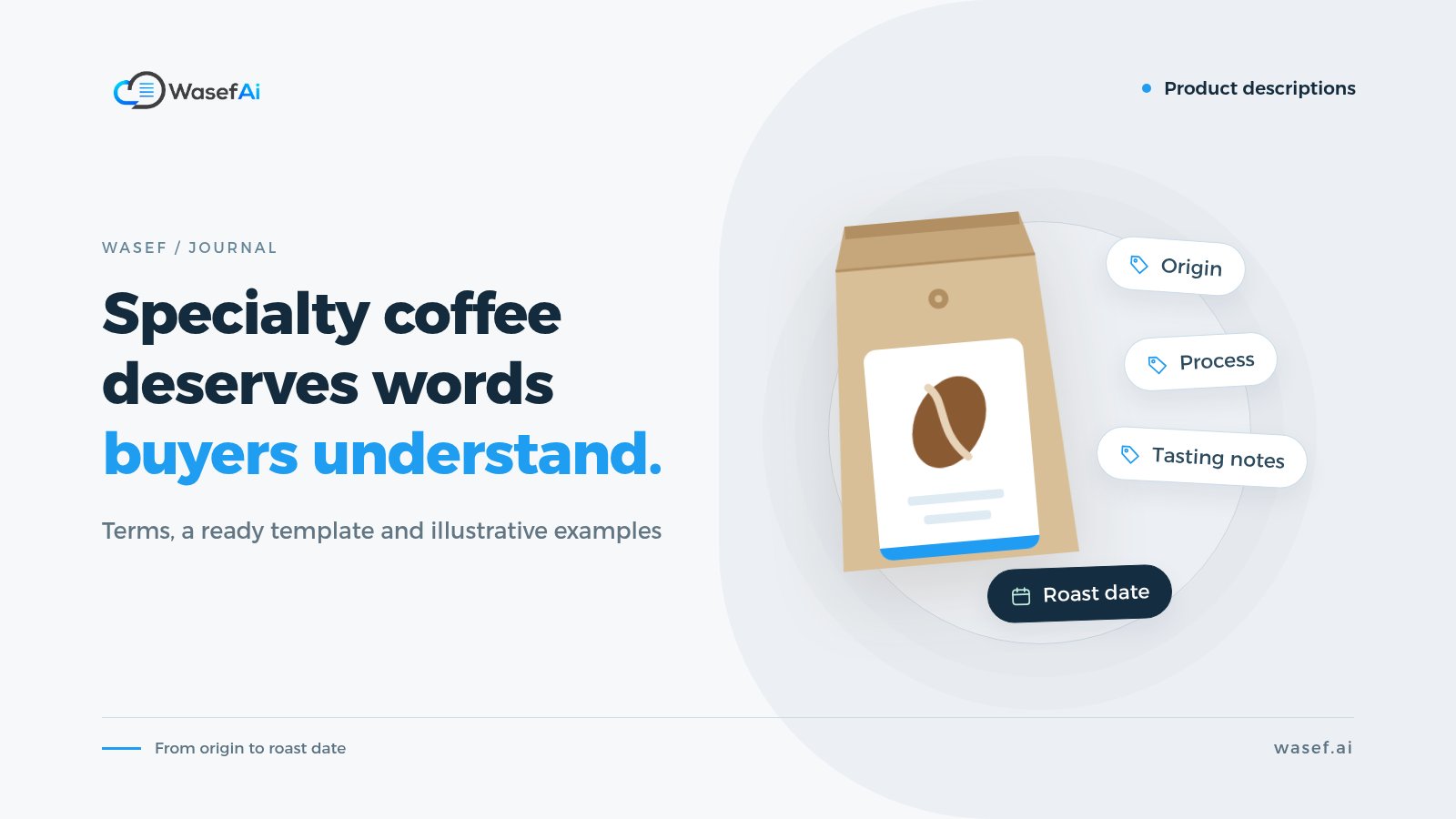
What describes a specialty coffee? Four core details: origin (the country and region, sometimes the farm), processing method (washed, natural or honey), roast level (light, medium or dark), and the tasting notes the roaster identifies, such as "jasmine, lemon, black tea". Those details are what set a bag of specialty coffee apart from a generic blend, and they help you pick a coffee that suits your taste and brewing method. To count as specialty on the Specialty Coffee Association's well-known cupping scale, a coffee needs to score 80 points or more out of 100, which we explain below.
If you run a roastery or a coffee store on Salla, you already know that specialty coffee customers read before they buy. They want to know where the beans come from, how they were processed, what they'll taste in the cup, and whether the coffee suits their V60 or their espresso machine. That's the job of a well-written coffee description: it answers those questions in plain language, without exaggeration and without jargon that loses the customer.
In this guide we start with a quick definition of specialty coffee itself, then explain the terms your customer sees on the product page, including how to describe coffee tasting notes honestly. After that you'll get a ready-made template for a coffee product page on Salla with two examples, and we finish with SEO tips that make your product easier to find.
What is specialty coffee, exactly?
The definition you'll hear most often comes from the cupping form published by the Specialty Coffee Association (SCAA at the time, SCA today) in 2004: the cup is scored out of 100 points across ten attributes, and any coffee that scores 80 points or more is considered specialty. That's why many roasters write something like "Cupping score: 86" on the product page.
But here's a point many people miss: the association itself now defines specialty coffee more broadly than a single number, as "a coffee or coffee experience recognized for its distinctive attributes, and because of these attributes, it has significant extra value in the marketplace." Those attributes include taste, aroma and mouthfeel, and also information about the coffee such as origin, producer, growing practices and processing methods. The association has also developed a newer evaluation system called the Coffee Value Assessment (CVA).
What does this mean for you as a merchant? It means a specialty coffee description is more than "tastes great". Customers pay more because they know the story and the specifications of the bean, so every accurate detail you write in the description is part of the value of the product itself.
How is it different from commercial coffee?
In short, and without overgeneralizing: commercial coffee is usually sold as a general blend without much detail about where it comes from, and its focus is on consistent taste and price. Specialty coffee usually comes with clear information about origin, processing and roast, and it's roasted in a way that brings out the character of the bean. That's why a specialty coffee product page needs more detail than an ordinary coffee product page.
How to describe coffee: the terms your customer sees
These are the terms that appear on most roasters' pages. Use them in your description, and if your audience is new to specialty coffee, add a half-line explanation next to each one.
- Country and region of origin: for example Ethiopia (Yirgacheffe, Sidamo, Guji) or Colombia (Huila, Nariño). The region is more precise than the country and gives the customer a clearer idea.
- Farm, producer or washing station: the name of the farm, cooperative or washing station, if your supplier gives it to you. Don't write a name you don't have confirmed information about.
- Altitude: written in metres above sea level, e.g. 1,800–2,000 m. It's usually linked to slower ripening of the coffee cherry, but don't promise a particular taste based on altitude alone.
- Variety: such as Bourbon, Caturra, Geisha or "Ethiopian heirloom varieties". Many experienced customers choose based on this.
- Processing method: how the bean was separated from the cherry and dried. The three best known are explained below.
- Roast level: light, medium or dark. Say which brewing method it suits: light roasts are common for pour-over, medium and darker roasts are common for espresso, and in the end it's your roastery's call.
- Tasting notes: such as "jasmine, lemon, black tea". These are the flavours a taster perceives in the cup; we come back to them in detail below.
- Acidity: this has nothing to do with stomach acidity. It means the bright, refreshing sensation in the taste, like citrus or apple. It's described as "low, medium, high" or as "citric" or "malic (apple-like)".
- Body: how heavy the coffee feels in your mouth: light like tea, medium, or full and creamy.
- Roast date: the day the batch was roasted. For specialty customers it matters more than the expiry date.
- Suitable brewing methods: such as V60, Chemex, AeroPress, French press, espresso. If you have a suggested recipe (coffee-to-water ratio and grind size), customers love that extra.
Washed vs natural coffee (and honey): what's the difference?
This is the point customers ask about most, so let's keep it simple. These are the three main coffee processing methods:
- Washed: the fruit and pulp are removed from the bean before drying. It usually gives a clean, clear cup with bright acidity.
- Natural (dry process): the whole cherry is dried with the bean still inside. It usually comes out fruitier and sweeter, with a heavier body.
- Honey: the skin is removed and part of the sticky mucilage stays on the bean while it dries. Its character usually falls between the other two. "Honey" here is the name of the method; there's no honey in it.
Notice the word "usually": processing gives a general tendency, but the actual taste depends on the bean itself, the roast and the brew. So write your description based on your own tasting of the batch, not just on the general rule.
Coffee tasting notes: how do you write them honestly?
The most common misunderstanding with customers new to specialty coffee: they see "berries, chocolate" and assume the coffee is flavoured. That's why you should make it clear in the description that tasting notes are natural flavours the taster perceives, not added flavourings. One sentence is enough, for example: "Tasting notes describe the flavours we perceive in the cup; the coffee has no additives."
- Write the notes that you or your tasting team actually noticed in the current batch. Don't copy them from the supplier's sheet if you haven't tasted them.
- Keep it to three or four notes. A list of ten flavours confuses the customer and reduces your credibility.
- Connect them to the customer's experience: "a light lemony acidity that comes through more as the coffee cools a little" is clearer than "citric acidity".
- If a new batch tastes different from the old one, update the description. Returning customers notice.
A coffee product description template for your Salla product page
Here is a template you can copy and fill in between the brackets. Order the information so the most important comes first, because many customers read the first two lines and skim the rest.
Opening line (one or two sentences):
Specialty coffee from [region], [country], [processing method] process, [level] roast. The cup is [a two-word overall description: clean and bright / fruity and sweet / balanced], and it suits [brewing methods].
Spec card (bullet list):
- Origin: [country – region]
- Producer or station: [name, if your supplier provides it]
- Altitude: [from – to] metres
- Variety: [name]
- Process: [washed / natural / honey]
- Roast level: [light / medium / dark]
- Tasting notes: [3–4 flavours]
- Acidity: [low / medium / high] – Body: [light / medium / full]
- Weight: [250 g / 1 kg]
- Cupping score: [only if you have a documented score]
What will you taste in the cup? (short paragraph):
[Describe the drinking experience in everyday language: the start, the middle, and once the coffee has cooled]. The tasting notes are natural flavours of the bean; the coffee has no additives.
How to brew it:
We suggest [brewing method] at a ratio of [e.g. 1:15] with a [fine / medium / coarse] grind. [Any notes from your own testing].
Roasting, freshness and storage:
We roast [every X days / to order], and the roast date is printed on the bag. We recommend [your guidance on resting time after roasting and how long to use it within]. Store it [storage method].
Two ready-made specialty coffee description examples
Note: the two examples below are for illustration only, and the values in them are hypothetical. They contain no farm names, because a farm name has to come from your supplier. Don't copy the tasting notes or numbers as they are; write what applies to your batch.
Illustrative example 1: washed Ethiopian
Product name: Ethiopian Specialty Coffee, Washed – Yirgacheffe – 250 g
Specialty coffee from the Yirgacheffe region of Ethiopia, washed process, light roast. The cup is clean and light with a bright lemony acidity, and it suits the V60 and Chemex.
- Origin: Ethiopia – Yirgacheffe
- Altitude: [per supplier data] metres
- Variety: Ethiopian heirloom varieties
- Process: washed
- Roast level: light
- Tasting notes: jasmine, lemon, black tea
- Acidity: high – Body: light
The first sip brings a floral aroma, followed by a gentle lemony acidity, and it finishes with a tea-like feel. The tasting notes are natural flavours of the bean; the coffee has no additives. We suggest a V60 at a 1:15 ratio with a medium-fine grind.
Illustrative example 2: natural Colombian
Product name: Colombian Specialty Coffee, Natural Process – Huila – 250 g
Specialty coffee from the Huila region of Colombia, natural (dry) process, medium roast. The cup is fruity and sweet with a fuller body, and it works for both pour-over and espresso.
- Origin: Colombia – Huila
- Altitude: [per supplier data] metres
- Variety: [per supplier data]
- Process: natural (dry process)
- Roast level: medium
- Tasting notes: strawberry, milk chocolate, caramel
- Acidity: medium – Body: medium to full
A sweet cup with a clear fruity character, and the chocolate comes through more as espresso. The tasting notes describe the flavours we perceive in the cup; there are no added flavourings. For espresso, try a 1:2 ratio and adjust for your machine.
Why does the roast date matter more than the expiry date?
Specialty customers know that coffee loses some of its aroma and flavour over time after roasting, so the roast date is the first thing they look for. That's why:
- Mention in the description that the roast date is printed on the bag, and say how often you roast (weekly, or to order).
- State your recommendation clearly: how many days after roasting it's ready, and within how many weeks you recommend using it. Make it your own recommendation from experience, not a borrowed number.
- A simple storage tip: an airtight bag, away from heat, sunlight and humidity.
- If beans are roasted after the order is placed and that delays shipping by a day or two, say so in the description. Customers accept the wait when they know the reason in advance.
Grind options: put them in the description or make them a choice?
Make grind a choice on the product itself, not a separate product for each grind. Salla supports text product options, so you can add a "Grind" option with values like:
- Whole bean (no grind)
- Espresso grind (fine)
- V60 pour-over grind (medium-fine)
- French press grind (coarse)
And in the description, add one line: "If you don't have a grinder, choose the grind that matches your brewer. Whole beans keep their flavour longer." That way the customer chooses correctly, and you get fewer orders coming back because of the wrong grind.
How do you make your coffee description show up in search?
A customer searching on Google rarely types your product's name. They type things like "washed Ethiopian coffee" or "specialty coffee for espresso". So put those words in the right places:
- Product name: start with the origin, process and weight, e.g. "Ethiopian Specialty Coffee, Washed – 250 g". That's far clearer than a marketing name like "Jasmine Morning" on its own. If you have a distinctive name for the batch, put it after the specifications.
- Page title and meta description: every product in Salla has its own SEO fields. We explain them step by step in our guide to Salla product SEO fields.
- URL (slug): short and clear, e.g. ethiopia-yirgacheffe-washed.
- Description text: use the words your customers actually use ("specialty coffee", "washed", "V60") naturally, without deliberate repetition.
- Category page: if you have a category like "Ethiopian coffee" or "Coffee for espresso", write a short introductory paragraph for it instead of leaving it as just a list of products.
- Image alt text: a photo of the bag and beans with a short description, e.g. "250 g bag of washed Ethiopian specialty coffee". If the photos themselves need work, see our guide to taking product photos with your phone.
That product name is also what reaches Google's shopping results if you connect Google Merchant Center to your Salla store.
Coffee marketing phrases: how to write them without exaggerating
A good marketing line for specialty coffee rests on a real fact, not on generic praise. Compare for yourself:
- Instead of "the best coffee in the Kingdom", write "lemony acidity and a jasmine note from the highlands of Yirgacheffe".
- Instead of "irresistible taste", write "clear strawberry sweetness, with the chocolate coming through more when you brew it as espresso".
- Instead of "always fresh", write "we roast every [day], and the roast date is on every bag".
A precise line sells better to a specialty customer, because they can verify it with the first cup. For more ideas, see our marketing phrases for online stores.
Common mistakes in specialty coffee descriptions
- One description copied across all products, with only the country name changed.
- Tasting notes copied from the supplier's sheet without tasting, or a long list of flavours.
- Mentioning a "cupping score" with no clear source for it.
- Hiding the roast date, or only giving the expiry date.
- Technical terms without explanation, like "Natural" and "Body", for a customer new to specialty coffee.
- Forgetting the suitable brewing methods, which is the question you'll get most in chat after a purchase.
If you sell other things alongside coffee, such as dates or sweets, the same approach works with our description templates for other categories.
And if you sell perfume or oud alongside coffee, we applied the same approach in our perfume description guide.
Should you write the description yourself or use AI?
Both work, on one condition: the core information has to come from you. AI doesn't know what you tasted in the batch, and it doesn't know the altitude of your supplier's farm. So if you use it, give it your spec card and the tasting notes you actually tasted, and let it handle the wording. We explain exactly what to give it in our guide to AI product description prompts.
Salla itself has a tool for generating descriptions with AI, and there are apps in the Salla App Store such as Wasef: it drafts an Arabic or English description from your product data, with an SEO title, a meta description and a suggested URL, and you review and edit it before publishing to your store. There's a free 7-day trial with no card if you'd like to try it on one product and see whether it fits the way you work.
Either way, check every number and every tasting note before you publish. In specialty coffee, an accurate description is part of the product's quality.
Sources
Tags
Before your next campaign, review your product pages with this checklist
Five steps on one page: what to check in your descriptions, how to fill in the SEO fields, and when to add a promotional title. Print it and work through it product by product.
Product page prep checklist
Ready before your next campaign
- Pick the products that will carry the season
- Review every page on mobile
- Fill in the SEO fields in product settings
- Promotional title: honest and temporary
- Spread the work over six weeks