Product Description Examples and Templates for Every Category
Ready-made product description templates for the most popular Saudi store categories, a filled-in example for each, and how to adapt them so every product gets a description of its own.
Wasef Team
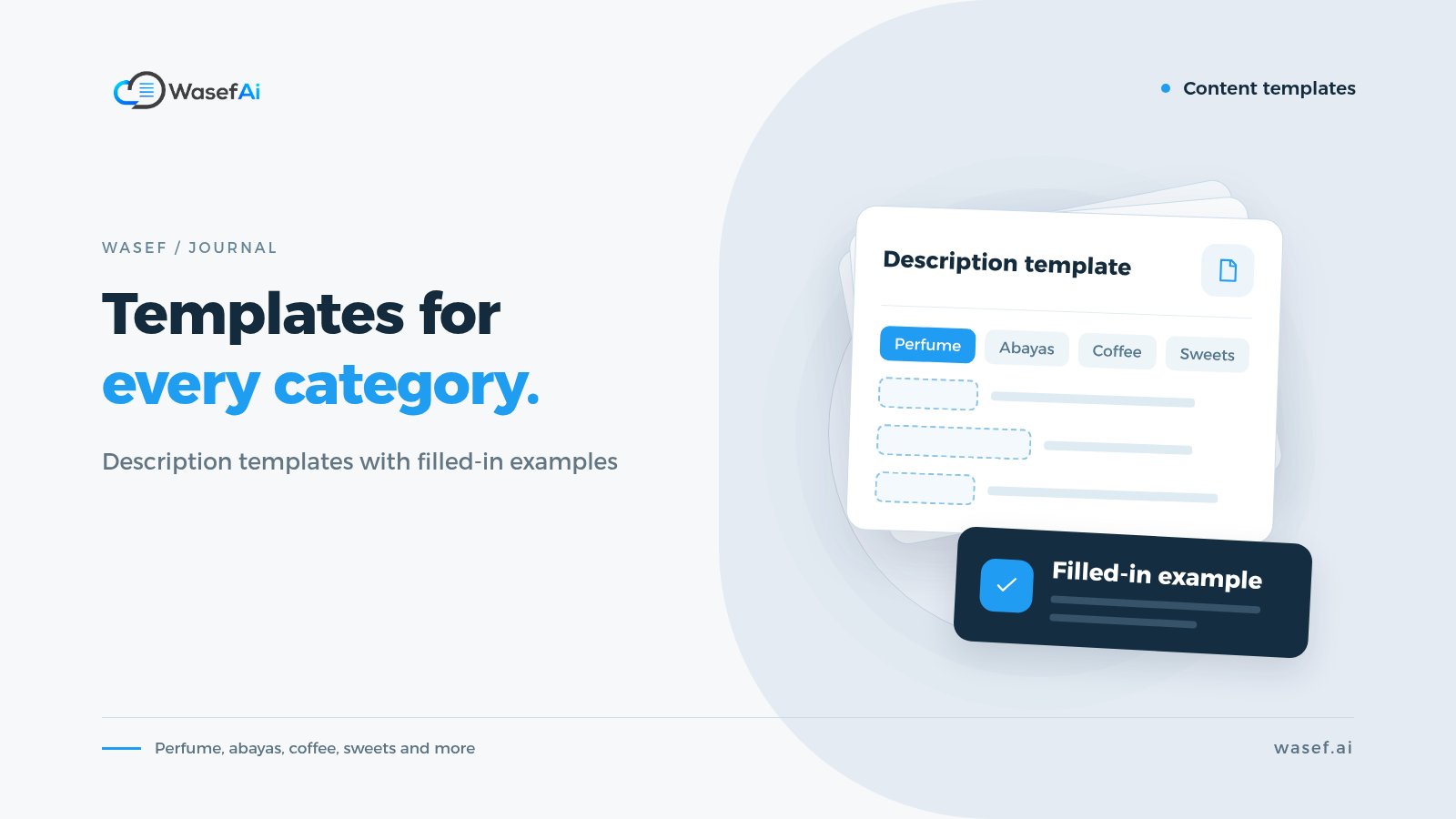
Looking for product description examples you can copy, paste and be done with? We get it, especially when you have dozens of products and every one needs a description. But a description copied as-is from the internet ends up on hundreds of other stores, and it doesn't answer your customer's questions about your product. What we suggest instead: a product description template for each category that you fill in with your own product details, plus a filled-in example that shows you what the finished version looks like.
In this guide you'll find a general structure that works for any product, followed by ready-made templates for the most popular categories in Saudi online stores: perfume, oud and bakhoor (traditional incense), abayas, clothing, accessories and watches, specialty coffee, dates, sweets and food products, and makeup and skincare. At the end, we explain how to adapt a template so you don't end up with twenty pages saying the same thing.
What is a product description, and how is it different from specifications?
A product description is the text that tells the customer what the product is, who it's for, and why it might suit them. Specifications are the fixed facts: size, weight, material, volume, country of origin, ingredients. Specifications answer "what exactly is it?", and the description answers "what does that mean for me?"
For example: "100% cotton" is a specification. "Breathable cotton fabric, comfortable for everyday wear in summer" is a description built on that specification. The best product descriptions combine both: clear copy at the top, and neatly organized specifications underneath that the customer can come back to whenever they need.
How to write a product description: the structure behind every template
Before the templates, here is the general structure. Every template below is built on it, and you can use it for any category we haven't covered:
- Opening: one or two sentences that answer "what is it, and who is it for?" The customer should know from the first line whether this product is meant for them.
- Benefits backed by specifications: every benefit you mention needs a fact behind it. "Lightweight" on its own is vague; "lightweight, at 180 grams" is a benefit with evidence.
- Specifications: a short list of numbers, materials and sizes exactly as the manufacturer gives them, or as you measured them.
- What's in the box: what exactly will the customer receive? Just the item? A box? A charger? A sample?
- Care or how to use: how to wash it, store it, use it. This part cuts down on questions and returns.
- Shipping and exchanges (if relevant): a short line pointing to your store policy, especially when the product has special conditions, such as opened items or food.
Keep in mind: the [square brackets] in the templates are the blanks you fill in. If you don't have the information for a blank, delete it. Don't guess.
Perfume description template: what to say about notes, concentration and longevity
A perfume description is one of the hardest to write, because the customer can't smell through a screen. Your job is to give them a clear picture in words they understand. A good perfume description mentions the fragrance family, the notes, the concentration, the size and the occasion.
The template
- [Perfume name] is a [family: woody / floral / oriental / fresh] fragrance in [eau de parfum / eau de toilette / parfum] concentration, suited to [who and when: evenings, work, special occasions].
- Top notes: [ ] — Heart notes: [ ] — Base notes: [ ].
- Overall feel: [a simple description of the impression: warm, clean, sweet, smoky].
- Size: [ml] — Country of origin: [ ] — Edition: [unisex / men / women].
- Longevity and projection: [only write the result of your own testing, or say it varies with skin and weather].
- How to apply: [where to spray and from what distance].
Illustrative example for a hypothetical product: the names and numbers here are for illustration only. Replace them with your real product details.
"Night Oud" is a woody oriental eau de parfum, made for evenings and special occasions in winter. It opens with saffron and cardamom, then Taif rose comes through, before settling on a base of oud and amber. The overall feel is warm and luxurious without being heavy. 100 ml, unisex. Longevity varies from skin to skin and with the weather; we suggest two sprays on your pulse points.
Important: don't write "lasts 24 hours" or "lasts 12 hours" unless you have actually tested it and can stand behind the number. Longevity depends on skin, heat and clothing, and a customer who tries it and doesn't get that number will come back with a bad review. "Long-lasting in our own testing on fabric" is more honest than a number you can't source.
For a deeper look at fragrance notes, concentration, longevity and sillage, with a fuller template and two examples, see our perfume description guide.
Oud, bakhoor and oud oil descriptions
Oud customers usually know what they want and ask about specific things: the type, the origin, the weight and how the smoke smells. So keep the description direct and precise.
The template
- [Product name]: [oud chips / bakhoor / oud oil] [type or origin as stated by the supplier], suited to [everyday use / hosting guests / special occasions].
- Scent: [describe the smoke or scent: sweet, smoky, incense-like, sharp].
- Weight or volume: [grams / tola / ml] — Form: [pieces / loose / blended bakhoor (mu'amal)].
- Composition: [natural / blended / perfumed] — state this honestly.
- How to use and store: [on charcoal or an electric burner; keep in an airtight box away from heat].
Illustrative example for a hypothetical product: the names and numbers here are for illustration only. Replace them with your real product details.
"Majlis" blended bakhoor (mu'amal), made for hosting guests and for the home, with a sweet, warm scent and a clear touch of oud. 50 grams in an airtight box. Use it on an electric burner or charcoal, and we recommend storing it away from sunlight so it keeps its scent.
The key point here: don't write "100% natural oud" or name a specific origin unless your supplier has given you something that proves it. Oud customers can tell the difference, and once trust is broken it's hard to win back.
Abaya description template
The most common questions about abayas are "how long is it?" and "is the fabric see-through?" A description that answers these before anyone asks saves you a lot of messages.
The template
- A [cut: flared / straight / bisht-style / kimono] abaya in [fabric], suited to [work / occasions / everyday wear].
- Details: [embroidery, buttons, pockets, wide or gathered sleeves].
- Fabric: [light / medium / heavy] — [sheer or opaque].
- Sizes: [lengths in centimetres] — with a clear size chart.
- Includes: [abaya only / with matching shayla (headscarf) / with niqab].
- Care: [hand wash or dry clean, iron on low heat].
Illustrative example for a hypothetical product: the names and numbers here are for illustration only. Replace them with your real product details.
The "Raml" abaya has a straight cut in medium-weight, opaque Japanese crepe, ideal for work and everyday outings. It has wide sleeves with delicate embroidery at the cuffs. Available in lengths 52 to 60, and it comes with a matching shayla in the same fabric. We recommend hand washing in cold water. Note: the colour in the photos may differ slightly depending on your screen.
Clothing product description: what you shouldn't leave out
With clothing, size is everything. Most returns come down to a size that didn't fit, so make your description help the customer choose correctly the first time.
The template
- [Item name], a [type] with a [slim / regular / relaxed] fit, suited to [occasion or season].
- Material: [percentages as on the label, e.g. 95% cotton, 5% elastane].
- Size: [size chart in cm] — the model is [ ] tall and wears size [ ].
- Fit advice: [true to size / we recommend sizing up].
- Care: [washing temperature, drying, ironing].
Illustrative example for a hypothetical product: the names and numbers here are for illustration only. Replace them with your real product details.
The "Daily" T-shirt has a slightly relaxed fit, made for summer and everyday wear. 100% cotton. The model is 180 cm tall and wears a size L. Because the cut is relaxed, if you prefer a closer fit, choose your usual size or one size down. Wash at 30°C; air drying is best.
Accessories and watch descriptions
For accessories and watches, customers look for the material, the size and the technical details. Any word that makes a promise ("won't tarnish", "water-resistant") must come from the manufacturer's specifications, not from your impression.
The template
- [Product name]: a [bracelet / necklace / ring / watch] in [material as stated by the manufacturer], suited to [the look or occasion].
- Sizes: [chain length / ring size / watch case diameter in mm].
- For watches: [movement type] — [water-resistance rating copied exactly from the manufacturer] — [strap material].
- In the box: [case, warranty, strap adjustment tools].
- Care: [avoid perfume and water if needed, how to clean it].
Illustrative example for a hypothetical product: the names and numbers here are for illustration only. Replace them with your real product details.
The "Masar" watch has a 40 mm stainless steel case, suited to work and formal outings. It has a quartz movement and a manufacturer water-resistance rating of 5 ATM. The brown leather strap is interchangeable, and it comes in a box with a warranty card.
Notice that we wrote the water-resistance rating exactly as it is, and didn't turn it into a promise like "you can swim in it". If you want to explain what the rating means, quote the manufacturer's own explanation.
Specialty coffee description
Specialty coffee lovers read descriptions carefully, and they care about origin, processing method and roast level. Generic copy like "premium coffee with an amazing taste" tells them nothing.
The template
- Coffee from [country / region / farm] — [process: washed / natural / honey] — [light / medium / dark] roast.
- Tasting notes: [as defined by the roaster].
- Best for: [filter / espresso / both].
- Weight: [grams] — [whole bean / ground, and grind size] — Roast date: [ ].
- Storage: [in an airtight bag, away from heat and humidity].
Illustrative example for a hypothetical product: the names and numbers here are for illustration only. Replace them with your real product details.
Ethiopian coffee from the Yirgacheffe region, washed process, light roast. Tasting notes according to the roaster: jasmine, lemon and black tea. Suited to filter brewers such as the V60 and Chemex. 250 grams, whole bean, with the roast date printed on the bag.
For the full terminology, processing methods and two complete examples, see our guide to writing a specialty coffee description.
Food product description: sweets, dates and packaged food
Here, the description isn't just marketing. It's information your customer needs for their health: ingredients, allergens, storage and shelf life. A lovely description of sweets that fails to mention they contain nuts can cause a real problem for a customer with an allergy.
The template
- [Product name]: [product type] [origin or how it's made], suited to [hosting / gifts / everyday use].
- Ingredients: [exactly as on the package label].
- Allergens: [e.g. contains nuts, milk, wheat, sesame / may contain traces of...].
- Net weight: [ ] — Number of pieces: [ ] if relevant.
- Storage: [temperature, refrigerate or not, after opening].
- Shelf life: [duration from production date, or "expiry date printed on the package"].
Illustrative example for a hypothetical product: the names and numbers here are for illustration only. Replace them with your real product details.
"Bait" ma'amoul (traditional date-filled shortbread cookies), coated with sesame, made for hosting guests and gifting. Ingredients: wheat flour, dates, ghee, sugar, sesame, cardamom. Contains: wheat, sesame and milk products. Net weight 500 grams (about 20 pieces). Store in a cool, dry place; after opening, an airtight container is best. Expiry date printed on the package.
Two important points: copy the ingredients and allergens from the product label itself, not from memory. And in Saudi Arabia, shelf life for food products is governed by technical regulations from the Saudi Food and Drug Authority, SFDA (such as SFDA.FD 150-1 and SFDA.FD/GSO 150-2). If you have a question about the requirements for your specific product, check with the SFDA directly.
Cosmetic product description: what are you allowed to say?
With makeup and skincare products, the easiest mistake to make is a medical claim. The SFDA defines claims as any information about a product's nature, effect, efficacy or contents, whether it appears on the product, in an advertisement or in any other promotional channel, including images and symbols. In other words, the description in your store falls under this definition.
The SFDA's "General Rules for Product Claims", published as a draft for public comment, states that cosmetic products must not carry medical or therapeutic claims, and must not be presented as treating or preventing a disease. So instead of "treats acne" or "cures eczema", stick to the cosmetic function: cleanses, moisturizes, gives a smoother appearance.
The template
- [Product name]: a [product type] for [skin or hair type], [cosmetic function: cleanses / moisturizes / covers].
- Texture and feel: [cream / gel / liquid] — [absorbs quickly or not].
- Key ingredients: [as on the label] — Full ingredient list: [ ].
- Size: [ml / g] — For makeup: [colour and shade, and finish].
- How to use: [amount, time of day, steps].
- Warnings: [for external use only, avoid the eyes, patch test on a small area of skin first].
Illustrative example for a hypothetical product: the names and numbers here are for illustration only. Replace them with your real product details.
"Nada" moisturizing cream for normal to dry skin, with a light creamy texture that absorbs quickly and leaves skin feeling soft. Contains glycerin and shea butter (full ingredient list in the product photos). 50 ml. Use morning and evening on clean skin. For external use only; we recommend a patch test on a small area of skin before first use.
Which words of praise actually work?
Phrases like "the best on the market" and "unmatched quality" are so overused that customers skip right past them. Praise that persuades links the quality to a reason:
- "Opaque fabric" instead of "luxurious fabric".
- "Roast date printed on every bag" instead of "always fresh coffee".
- "Double stitching at the shoulders" instead of "high quality".
- "Gift-ready, comes in a wrapped box" instead of "the perfect gift".
If you can't explain the "why" behind the praise, it's probably filler, and you can delete it without the description losing anything. For more ideas, see our list of marketing phrases for online stores.
How do you adapt product description examples and templates without creating duplicate content?
This is the trap many stores fall into. A template saves you time, but if you fill the same sentences into twenty products and only change the name, you now have twenty near-identical pages. The result: the pages compete with each other, and none of them offers anything different to the customer or the search engine. To see why that matters, read why SEO matters for product descriptions.
In its guidance on helpful content, Google poses a clear self-assessment question: if the content draws on other sources, does it avoid simply copying or rewriting those sources, and instead provide substantial additional value and originality? The same logic applies to your templates and to supplier descriptions.
So:
- A template is a structure, not a script: use it to remember what to write, not to copy the same sentences.
- Rewrite the opening for every product: it's the part that sets the product apart most, so don't repeat it.
- Focus on the difference: what makes this perfume different from the one next to it in the same category? The notes? The occasion? The size? That's what deserves to be at the top of the description.
- Same product in different colours or sizes: consider making it one product with options instead of separate pages with the same description.
- Keep the fixed parts short: a care or shipping line can repeat across products, and that's normal, but it shouldn't make up most of the description.
If you have a supplier description and want to turn it into one that belongs to your store, see our guide to rewriting supplier product descriptions. If you want to hand these templates to an AI tool, this guide explains what to give it so you get an accurate description; make the template part of your instructions, together with your real product data. And once the description is done, don't forget the SEO fields for each product in Salla: the page title, meta description and URL.
Templates work well for a handful of products. Once you're filling the same template for dozens of them, Wasef can take the first pass: it drafts each description from that product's own data, with an SEO title, meta description and suggested URL, so the details differ from page to page. You edit each draft before it's published to Salla, and you can try it on a few products free for 7 days, with no card.
Sources
- Google Search Central: Creating helpful, reliable, people-first content
- Saudi Food and Drug Authority: launch of the cosmetic product claims assessment service (Arabic)
- Saudi Food and Drug Authority: General Rules for Product Claims (draft for comment, 2021, Arabic)
- Saudi Food and Drug Authority: technical regulations on food product expiration dates
Tags
Before your next campaign, review your product pages with this checklist
Five steps on one page: what to check in your descriptions, how to fill in the SEO fields, and when to add a promotional title. Print it and work through it product by product.
Product page prep checklist
Ready before your next campaign
- Pick the products that will carry the season
- Review every page on mobile
- Fill in the SEO fields in product settings
- Promotional title: honest and temporary
- Spread the work over six weeks