How to Write a Perfume Description: Fragrance Notes, Concentration and a Template
How to describe a perfume so shoppers can imagine the scent before they smell it: fragrance notes, eau de parfum vs. eau de toilette, honest longevity and sillage, plus a template and two examples.
Wasef Team
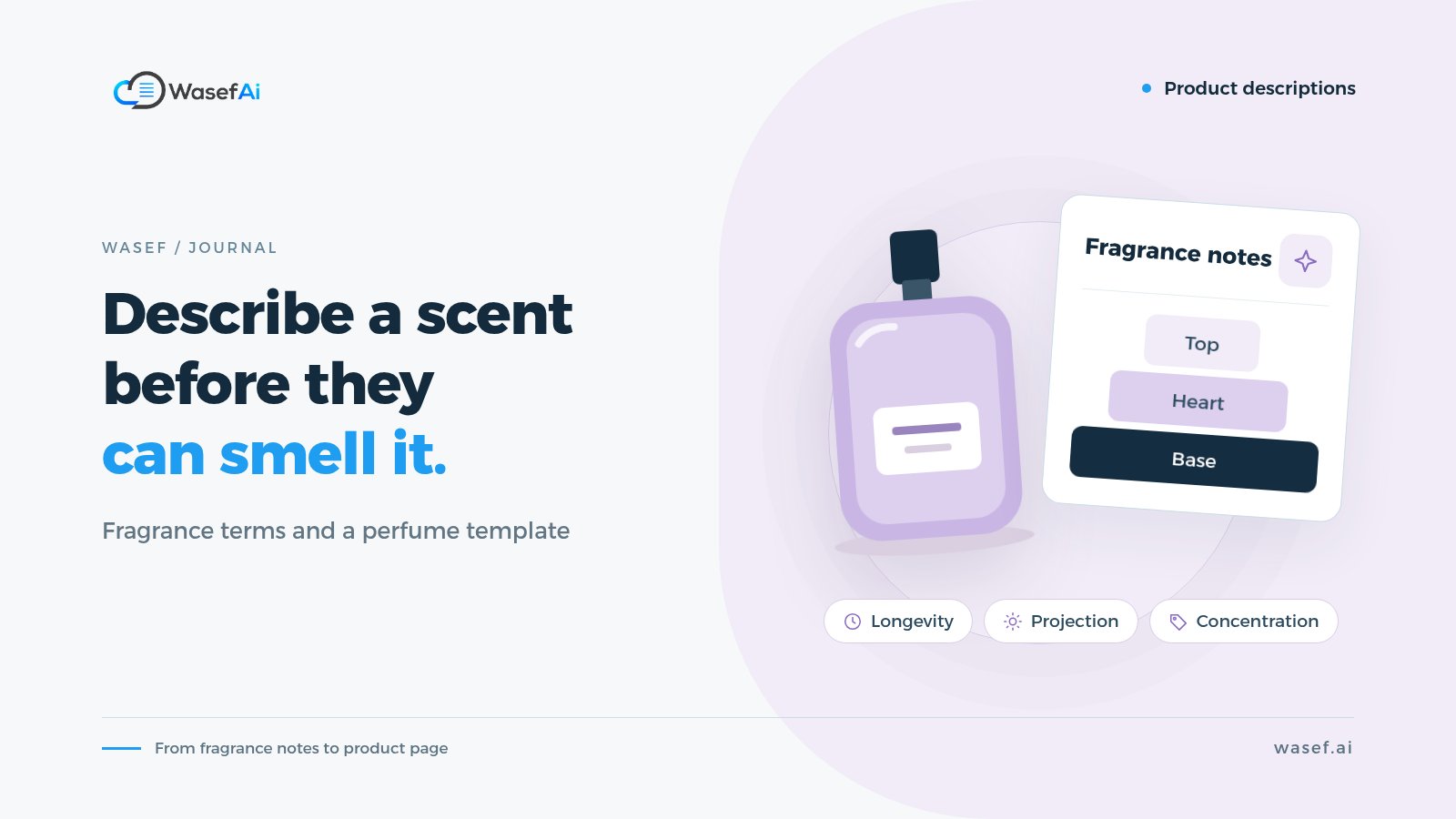
What goes into a good perfume description? Six core details: the fragrance name, concentration and size (such as "Eau de Parfum, 100 ml"), the fragrance family (woody, floral, amber or fresh), the fragrance notes in three layers (top, heart and base), an honest description of longevity and sillage, and when and who it suits. Together they make up for the one thing a shopper can't do online: smell the perfume.
If you sell perfume or oud online, you know the problem. In a shop, a customer sprays, smells and decides in a minute. Online, all they have is a photo of the bottle and the words you wrote. If your description says "a luxurious long-lasting fragrance", they've learned nothing new, and they'll go to a store that explains more.
This guide covers fragrance notes and the terms shoppers look for, how to describe longevity and sillage without exaggerating, a ready-made perfume description template with two examples, and words to describe a scent.
What are fragrance notes? Top, heart and base explained
Most perfumes are described as a "pyramid" with three layers, because the scent changes over time after you spray it:
- Top notes: the first thing you smell. Usually light and quick to fade, such as citrus, bergamot or mint.
- Heart (middle) notes: they appear once the opening settles, and they give the perfume its character. Think rose, jasmine or soft spices.
- Base notes: the last and longest-lasting layer on skin and clothes, such as oud, amber, musk, vanilla or sandalwood.
Why does this matter in a product description? A shopper who reads "bergamot opening, Taif rose heart, oud and musk base" can imagine the scent and compare it with perfumes they've tried. That's exactly what they need to decide.
A practical tip: don't copy a list of 20 notes from the brand's website. Pick two to four standout notes per layer, the ones people actually notice.
Perfume concentration: eau de parfum vs. eau de toilette
Concentration is the share of fragrance oils in the perfume, and it's one of the first things shoppers ask about. Typical market ranges are roughly:
- Parfum or Extrait de Parfum: the highest concentration, around 20% and above.
- Eau de Parfum (EDP): around 10–20%. The most common concentration in perfume stores.
- Eau de Toilette (EDT): around 5–15%, often lighter and better suited to everyday wear.
- Eau de Cologne (EDC): around 2–5%, very light.
One important caveat: these ranges are market conventions, not legal standards, and they vary between brands. One brand's eau de toilette can be stronger than another brand's eau de parfum. List the concentration exactly as it appears on the box, and don't promise a specific longevity based on concentration alone.
If you sell oud oil (dehn al oud) or other perfume oils, say so clearly. They're applied differently and wear differently from sprays, and many shoppers search for them by name.
What are the main fragrance families?
A fragrance family sums up a perfume's character in a word or two. The best-known system uses four main families:
- Floral: rose, jasmine, orange blossom. Soft, and often associated with women's perfumes, though not always.
- Amber (formerly called Oriental): amber, vanilla, warm spices, resins. Warm and relatively heavy.
- Woody: oud, sandalwood, cedar, vetiver. Deep and long-lasting, and especially popular in the Gulf.
- Fresh: citrus, aquatic notes, green herbs. Light, and good for summer and daily wear.
Many perfumes combine two families, such as "woody amber" or "fresh floral". Describe them that way, because it's more precise for shoppers.
How to describe longevity and sillage without exaggerating
This is where merchants exaggerate most, and where they lose shoppers' trust most.
- Longevity: how long the scent stays noticeable on skin or clothes.
- Sillage: how far the scent projects around you and how much people nearby notice it. The word is French for "wake", like the trail a boat leaves behind.
Both depend on skin type, weather, clothing and how much you apply. Instead of "lasts 48 hours" or "beast-mode projection", write something shoppers can believe:
- "In our testing on clothes, the base notes were still noticeable at the end of the day."
- "Moderate sillage: people close to you will notice it without it overwhelming a closed room."
- "It wears lighter on skin than on fabric, so for longer wear, spray it on your scarf or abaya."
This wording is honest, sets realistic expectations, and cuts down on returns and negative reviews.
Words to describe perfume
If you're stuck at "smells nice", here are more precise words, as long as they're true for your perfume:
- Warm: amber, vanilla or spices. Suits winter and evenings.
- Fresh: citrus, mint or aquatic notes. Suits summer and work.
- Soft or powdery: light and close to the skin, like white musk or iris.
- Smoky: oud, incense or leather notes.
- Spicy: cardamom, clove, saffron or pepper.
- Sweet: vanilla, caramel or fruit.
- Clean: that fresh-laundry, soap-like feel, often from musk.
For ready-made marketing lines for perfume and incense, see our marketing phrases for online stores.
A ready-made perfume description template
Copy this template and fill it in for your perfume. Delete any line you don't have accurate information for:
- Opening line: one sentence on the perfume's character and who it's for. (Example: "A warm woody fragrance for men, pairing oud with a touch of rose.")
- Concentration and size: Eau de Parfum, Eau de Toilette or oud oil, plus the size in ml.
- Fragrance family: such as woody amber.
- Fragrance notes: top, heart and base (two to four notes per layer).
- Longevity and sillage: in realistic terms, like the examples above.
- When to wear it: daily, evening, occasions, summer or winter.
- Who it's for: men, women or unisex.
- Packaging details: country of origin, brand, and anything printed on the box.
- How to use it: where to spray it, or how to apply the oil.
If you sell the same perfume in several sizes, use product options in Salla instead of creating a separate product for each size.
Two perfume description examples
The products below are hypothetical. They show how the template reads once it's filled in.
Example 1: a woody Eau de Parfum
"Najd Night" Eau de Parfum, 100 ml
A warm woody amber fragrance for men, suited to evenings and occasions.
- Top notes: bergamot and cardamom.
- Heart notes: Taif rose and saffron.
- Base notes: oud, amber and musk.
Longevity: in our testing on clothes, the oud base was still noticeable at the end of the day. Sillage is moderate for the first two hours, then it settles closer to the skin. Better for winter and evenings than for summer office days. Spray on the neck and scarf from about a hand's length away.
Example 2: oud oil
"Ghaim" Oud Oil, 3 ml
A smoky woody oud oil that sits heavy and close to the skin.
- Type: pure oud oil, alcohol-free.
- Scent: opens smoky and slightly sharp, then softens after about half an hour into a warm woody scent with a light sweetness.
- How to use: a small amount on the wrist or behind the ear with the applicator is enough.
- Longevity: oud oil usually lasts longer than sprays, but its sillage stays closer to the skin.
Notice that neither example says "the best perfume on the market" or "lasts 72 hours". Every line gives the shopper something to base a decision on.
SEO tips for perfume product pages
- Product name: include the type, concentration and size, such as "Oud Eau de Parfum for Men, 100 ml". This name is what shows in Google, and it's the same title that reaches Shopping results if you connect Google Merchant Center to your Salla store.
- Page title and meta description: use the words your shoppers actually search for, such as "men's oud perfume" or "Cambodian oud oil". Our guide to Salla's product SEO fields explains each field.
- Clear photos: the bottle from several angles, the box, and a shot next to something that shows its size. See our phone product photography guide.
- Don't copy the brand's description word for word: the same text appears on hundreds of stores. Describe your own experience of the perfume.
Common perfume description mistakes
- Promising longevity in hours that you can't back up.
- Long copied note lists that don't say which notes actually stand out.
- Calling a product "original" when you can't prove it. If a perfume is inspired by a well-known fragrance, say so plainly without implying it's the same product.
- Using the same description for every perfume and changing only the name.
- Leaving out concentration and size, the first two details shoppers look for.
Should you write descriptions yourself or use AI?
Both work, as long as the core information comes from you. AI hasn't smelled the perfume and doesn't know how it wore after two hours. Give it the concentration, notes and your impression of longevity, and let it handle the wording. We explain exactly what to give it in our AI product description prompt guide.
Wasef is a Salla app that drafts product descriptions from your product data, in Arabic and English, along with an SEO title and meta description. You review and edit the draft before publishing. There's a 7-day free trial with no card required. We applied the same approach to coffee in our specialty coffee description guide, and to other categories in our product description templates.
Sources
Tags
Before your next campaign, review your product pages with this checklist
Five steps on one page: what to check in your descriptions, how to fill in the SEO fields, and when to add a promotional title. Print it and work through it product by product.
Product page prep checklist
Ready before your next campaign
- Pick the products that will carry the season
- Review every page on mobile
- Fill in the SEO fields in product settings
- Promotional title: honest and temporary
- Spread the work over six weeks