How to Write a Heater Product Description: Heater Types, Specs and a Template
How to write a heater description that answers shoppers' questions before winter: oil-filled vs. fan, ceramic, halogen and gas heaters, the specs to include, and honest safety wording, plus a template and two examples.
Wasef Team
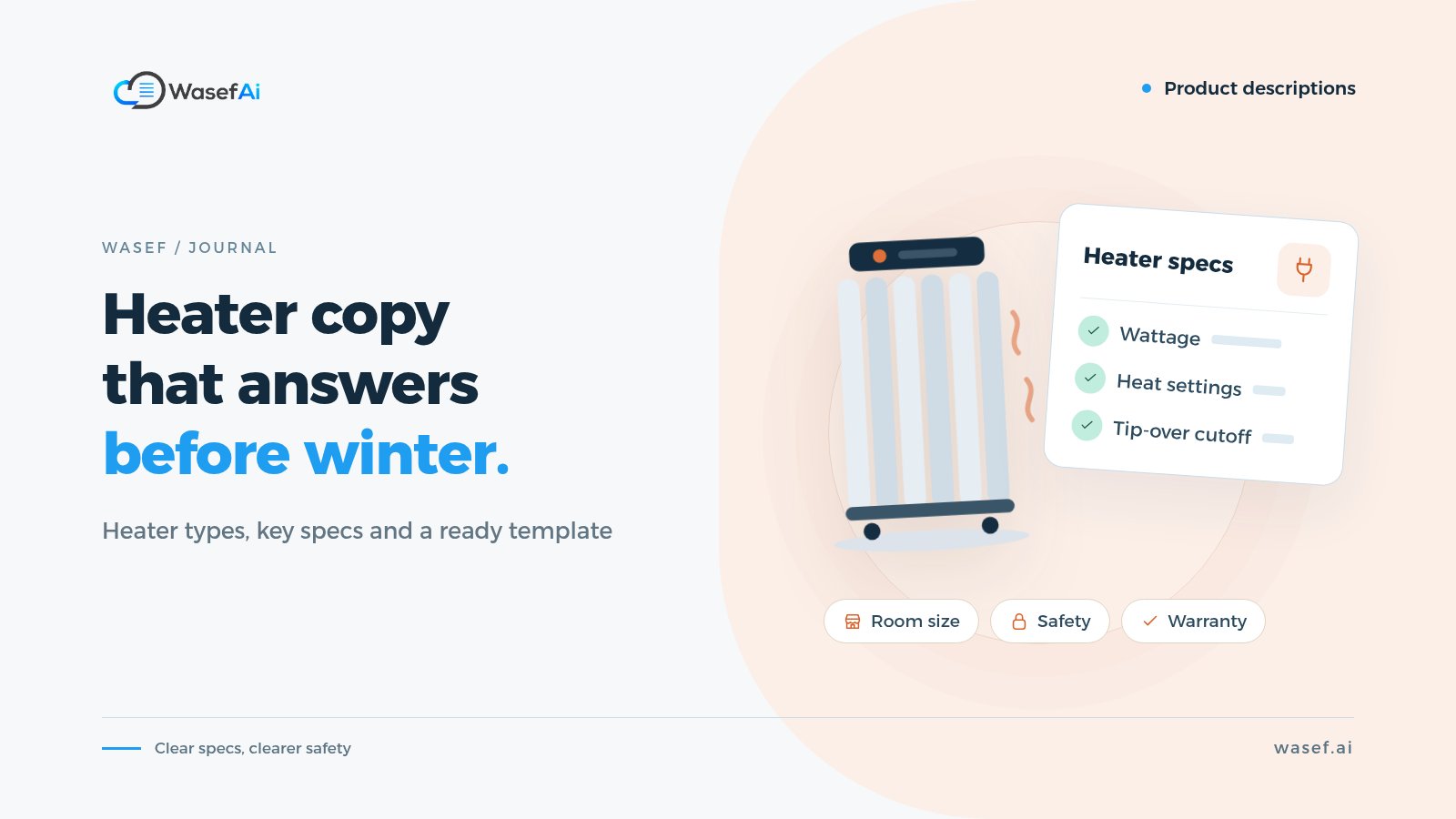
What goes into a good heater description? Seven core details: the heater type (oil-filled, fan, ceramic, halogen or gas), its wattage and heat settings, whether it has a thermostat, the room size it suits according to the manufacturer, safety features such as a tip-over switch and overheat protection, how much noise it makes, and practical details like cord length and plug type. These are the questions shoppers ask before buying, and if your page doesn't answer them, they'll message you on WhatsApp or go to another store.
Heaters are a classic seasonal product. In Saudi Arabia, searches for them start rising in October, peak in December, then drop quickly as winter ends. That gives you a short window, and the pages that are ready before the cold arrives are the ones that benefit.
This guide covers the types of heaters and how to explain the differences to shoppers, the specs every description needs, and how to write honestly about safety and electricity use. Then you'll get a ready-made heater description template with two examples.
What are the types of heaters, and how do you explain the difference?
Most shoppers don't know the difference between heater types, so they choose on price or looks. When you explain how each type heats and where it works best, you help them choose well, and you get fewer returns and fewer reviews saying "it doesn't heat".
- Oil-filled radiator: metal fins filled with oil that's heated electrically and gives off heat into the room. It takes a while to warm up, but the heat is gentle and even, and it's almost silent because there's no fan. It suits bedrooms and sitting rooms where people stay for a long time.
- Fan heater: a heating element and a fan that blows out warm air. It heats up fast, and it's usually small and cheaper, but you can hear the fan. It suits an office or a small room you want to warm quickly.
- Ceramic heater: a type of fan heater with a ceramic heating element. Many are small and light and come with a thermostat. Don't call it "more economical" than other types unless you have the manufacturer's figures to back that up.
- Halogen or quartz (radiant) heater: it warms whatever is directly in front of it instead of heating the air in the whole room, so you feel the warmth as soon as you switch it on. It suits sitting in one spot in front of it, and it's less useful for heating a whole room. Mention that it gives off light, because some people don't want that at bedtime.
- Wall heater: mounted on the wall to save floor space. Say whether installation needs a technician, and whether the fittings and screws are in the box.
- Gas heater: runs on a gas cylinder and needs no electricity, so many people buy one for camping, rest houses (istirahas) and open spaces. It's the type that most needs clear warnings in the description, which we cover below.
Which specs should a heater description include?
You'll find these details in the user manual, on the box, or on the supplier's spec sheet. Copy them accurately, and don't guess any figure:
- Wattage and heat settings: such as "2000 W with three settings: 800, 1200 and 2000 W". Lower settings help shoppers who want gentle warmth without running it on high all the time.
- Thermostat: does the heater switch itself off and on to hold a set temperature? This is one of the most important features, so mention it if it's there.
- Suitable room size: give it exactly as the manufacturer states it, and attribute it: "According to the manufacturer, suitable for rooms up to 20 square meters." Don't calculate it yourself from the wattage, because insulation, ceiling height and weather make a big difference.
- Safety features: a tip-over switch that cuts power if it falls or tilts, overheat protection, and on gas heaters an oxygen depletion sensor if it has one. Name only the features it actually has.
- Noise: does it have a fan? If you don't have a decibel figure from the manufacturer, describe it realistically from your own testing, such as "the fan is audible in a quiet room".
- Practical details: cord length, plug type, weight, wheels or handle, remote or timer, and dimensions.
- Warranty and what's in the box: how long the warranty is, who provides it, and what comes with the heater.
How do you write about electricity use without exaggerating?
"Saves electricity" is one of the most common phrases on heater pages, usually with no figure behind it. An electric heater draws roughly the wattage written on it while it runs on that setting. What really makes the difference is how many hours it runs, on which setting, and whether a thermostat switches it off once the room reaches the set temperature.
So instead of "incredible energy savings", write something shoppers can check:
- "It has a low 800 W setting for gentle warmth instead of running at 2000 W."
- "The thermostat stops heating once the room reaches your chosen temperature, and starts again when it cools down."
- "It has a timer you can set to switch it off after a number of hours."
This wording is honest, and it gives shoppers a sensible reason to choose your heater without a promise you can't back up.
Why should safety warnings be in the description?
Some merchants worry that warnings will scare shoppers off. It's the opposite: someone buying a heater for their children's room is reassured when they see you understand the product and care about safety. Many of the basic guidelines are repeated by safety bodies such as the US Consumer Product Safety Commission (CPSC):
- Keep the heater away from bedding, curtains, furniture and anything flammable. The CPSC recommends at least 3 feet (about one meter).
- Don't leave the heater running while you sleep or when you leave the room.
- Place it on a stable, level surface.
- Follow the manufacturer's instructions on the electrical connection. Many manufacturers advise plugging it directly into a wall socket rather than an extension lead.
Gas, wood and charcoal heating: ventilation first
If you sell gas heaters or wood and charcoal heating products, the warning isn't an extra. It's a core part of the description. Saudi Civil Defense warns every winter against using charcoal and wood for heating in enclosed spaces, because the carbon monoxide they produce can be fatal if someone breathes it in a poorly ventilated space. It recommends ventilating the space and using heating equipment that meets the required specifications.
For gas heaters in particular, state clearly where they can be used according to the manufacturer's instructions (open or well-ventilated spaces), whether there's an oxygen depletion sensor that switches the heater off automatically, and whether a safety valve cuts the gas if the flame goes out. Don't write "safe indoors" unless the manufacturer says so in the manual.
What about conformity certificates in Saudi Arabia?
The Saudi Standards, Metrology and Quality Organization (SASO) runs the Saber platform, which issues conformity certificates and shipment certificates for imported and locally made products before they reach the market. Requirements vary by product and its technical regulation, so check with your supplier or a specialist that the heater you sell is registered and compliant.
In the description: if you have an actual conformity certificate for the product, mention it, because it reassures shoppers. If you don't, don't write "complies with Saudi standards", and don't put any authority's logo on your photos.
A ready-made heater description template
Copy this template and fill it in for your heater. Delete any line you don't have confirmed information for:
- Opening line: the heater type and where it works best, in one sentence. (Example: "A quiet oil-filled heater for bedrooms and small sitting rooms.")
- How it heats: one line on how it warms the space (even heat, fast warm air, or direct warmth for whoever is in front of it).
- Wattage and settings: the maximum wattage and the heat settings.
- Controls: thermostat, timer, remote, display.
- Suitable room size: as stated by the manufacturer.
- Safety: the features it actually has, by name.
- Noise and size: whether it has a fan, plus dimensions, weight and cord length.
- Usage warnings: two or three lines from the manufacturer's manual.
- Warranty and what's in the box.
For templates for other categories, see our product description templates.
Two heater description examples
The products and figures below are hypothetical. They show how the template reads once it's filled in. In your store, take every figure from your product's manual.
Example 1: an oil-filled heater for the bedroom
"Dafa" Oil-Filled Heater, 11 Fins, 2000 W
A quiet oil-filled heater for bedrooms and small sitting rooms. It takes a few minutes to warm up, then gives even heat across the room with no fan noise.
- Power: 3 settings: 800, 1200 and 2000 W.
- Controls: a dial thermostat that holds the temperature you choose.
- Room size: according to the manufacturer, suitable for rooms up to 20 square meters.
- Safety: tip-over switch and overheat protection.
- Size: 4 wheels and a handle for moving it between rooms, with a 1.5 m cord.
Note: the surface gets hot while it's running, so keep it away from curtains and bedding, and don't cover it or dry clothes on it. 2-year warranty from the authorized dealer.
Example 2: a gas heater for camping
"Barriya" Gas Heater for Open Spaces
A gas heater for desert trips (kashta), camps and outdoor gatherings. No electricity needed.
- Operation: runs on a gas cylinder (cylinder not included), with a built-in igniter and 3 flame settings.
- Safety: an oxygen depletion sensor that switches it off automatically, a valve that cuts the gas if the flame goes out, and a tip-over switch.
- Where to use it: according to the manufacturer's manual, open or well-ventilated spaces only.
Important: don't run it inside a closed tent or room, and don't sleep while it's on. Burning gas produces carbon monoxide, a gas with no smell or color.
Notice that neither example says "the most powerful heater" or "saves 70% on electricity". Every line gives the shopper something to base a decision on, and the warning is written in plain language without scaremongering.
SEO tips for heater product pages
- Product name: include the type and wattage, such as "Electric Oil-Filled Heater 2000 W, 11 Fins". Shoppers search by type: in Arabic, terms for oil heater (دفاية زيت), gas heater (دفاية غاز), fan heater (دفاية مروحة), wall heater (دفاية جدارية) and small heater (دفاية صغيرة) all get real search volume in winter.
- Page title and meta description: use the same words your shoppers use. Our guide to Salla's product SEO fields explains each field.
- Get the page ready before the cold: heater searches rise from October and peak in December. A page published mid-season takes time to show up in search. And if you connect Google Merchant Center to your Salla store, your products can appear in Shopping results under the same name.
- Don't copy the supplier's description: it's often a literal translation repeated across dozens of stores. We explain how to turn it into your own description without losing the specs in rewriting supplier product descriptions.
Common heater description mistakes
- "Saves electricity" with no figure or feature to explain it.
- A room size calculated by the merchant instead of the manufacturer.
- A gas heater with no ventilation warning.
- "100% safe" or "child-safe" with nothing in the product manual to support it.
- Leaving out noise, a common reason people who buy a heater for the bedroom are unhappy.
- Not explaining the return policy for a seasonal product. If you need one, see our return and exchange policy template.
If you sell other winter products, see winter clothing and farwa descriptions and kashta and camping gear descriptions. To see what a product page of yours is missing right now, try our free SEO check for Salla product pages.
Should you write descriptions yourself or use AI?
Both work, as long as the figures come from you. AI hasn't seen your heater's manual and doesn't know whether it has a tip-over switch. Give it the specs from the box and the manual, let it handle the wording, then check every figure before you publish.
Wasef is a Salla app that drafts product descriptions from your product data, in Arabic and English, along with an SEO title and meta description. You review and edit the draft before publishing. There's a 7-day free trial with no card required. Try it on one heater before the season and see whether it fits the way you work.
Sources
Tags
Before your next campaign, review your product pages with this checklist
Five steps on one page: what to check in your descriptions, how to fill in the SEO fields, and when to add a promotional title. Print it and work through it product by product.
Product page prep checklist
Ready before your next campaign
- Pick the products that will carry the season
- Review every page on mobile
- Fill in the SEO fields in product settings
- Promotional title: honest and temporary
- Spread the work over six weeks