How to Describe Camping Gear for Your Online Store: What Shoppers Need to Know, with a Template and Two Examples
How to write product descriptions for kashta and camping gear: what to say about tents, bait al-sha'ar, fire pits, dallahs, chairs and lighting, how to describe a "complete kashta kit", and the safety notes every description needs, with a template and two examples.
Wasef Team
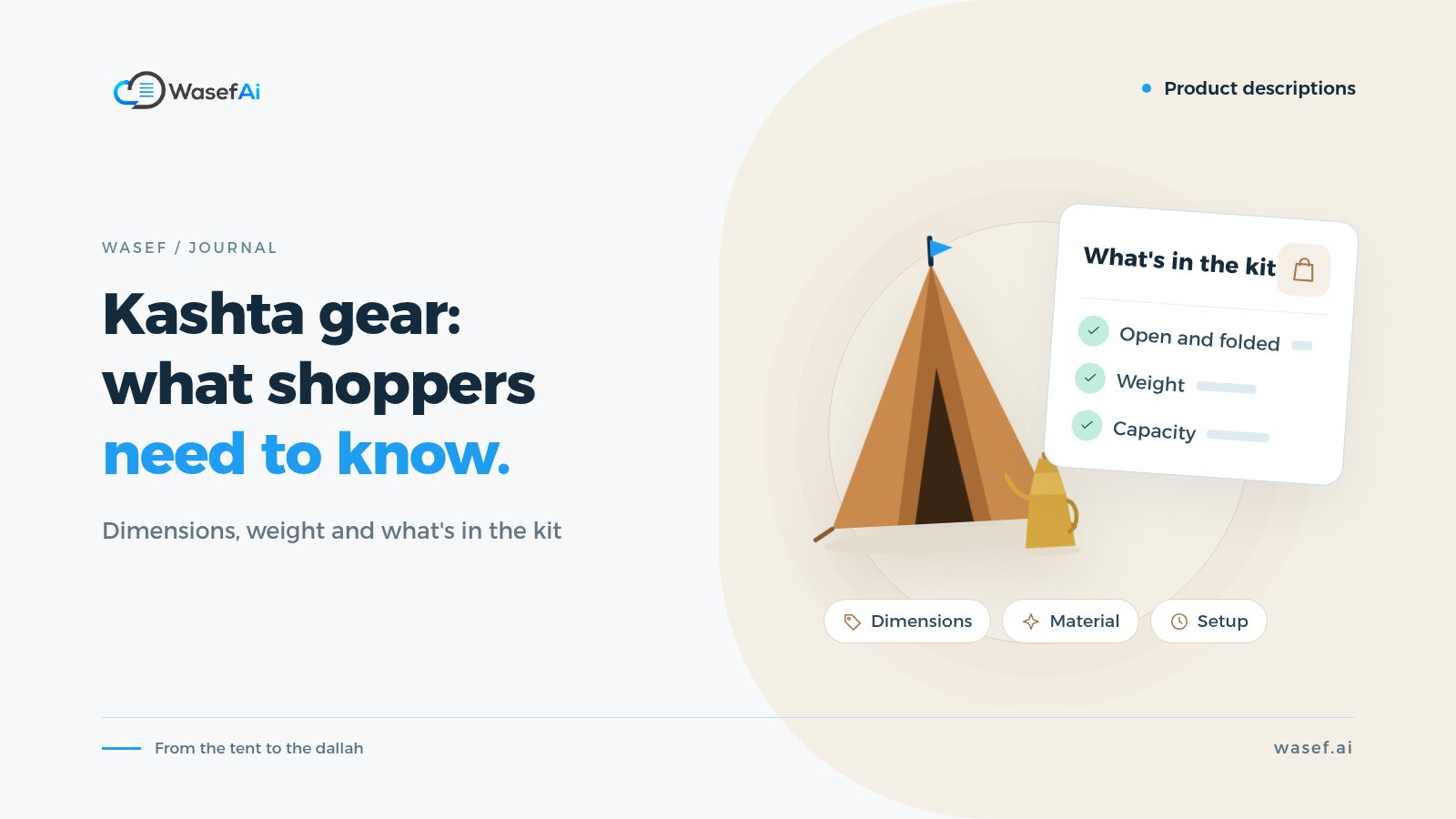
What does a good camping gear description need? Seven core details: dimensions both set up and folded, weight, materials, capacity (how many people or how many litres), exactly what comes in the bag, how it's set up and roughly how long that takes, and the right safety warnings. Your customer will carry this gear out into the desert, far from any shop, so before buying they want to know: will it fit in the car boot? Can one person set it up? Is it big enough for the family or the group?
When winter arrives in Saudi Arabia, so does kashta season: day trips and overnight camping in the desert (kashta, كشتة). Searches for tents, fire pits, chairs and dallahs climb. Shoppers compare many stores selling similar products, and most of them just say "excellent tent for trips". That sentence doesn't answer a single question the customer has.
This guide walks through the most popular kashta gear categories and what to write for each, how to describe a "complete kashta kit" without surprising the customer, and then gives you a ready-made template and two examples.
Why are camping gear descriptions different from other products?
Because the customer won't use it at home. They'll use it somewhere with no backup. If the tent is missing a peg, the fire pit doesn't fit in the boot, or the chair is lower than they imagined, the whole trip suffers. On top of that, these products are often large and heavy, so returns are costly for you and for the customer.
So this isn't the place for flowery copy. The description is a written answer to the questions the customer would have asked you in a shop.
Tents and bait al-sha'ar: what to include
Tents and bait al-sha'ar (بيت شعر, the traditional Bedouin tent woven from goat hair) are among the most searched winter items, and they raise the most questions. Make these details clear:
- Size when set up: length, width and centre height. Height matters: can the customer stand inside, or only sit?
- Capacity: give the capacity the manufacturer states, and say whether it's for sleeping or sitting. A "4-person" tent may sleep four people with no luggage but feel tight once their bags are inside. One sentence explaining this can save you negative reviews.
- Materials: the fabric, the pole type (steel, aluminium or fibreglass) and the floor, if there is one. For bait al-sha'ar: is it natural hair or a synthetic material, and does it have a lining?
- Size and weight when folded: this decides whether it fits in the car boot. Don't give only the set-up size.
- Setup: how many people it needs and roughly how long it took in your own testing. "We tried it and two people set it up in about 15 minutes" is more believable than "easy to set up".
- Rain and wind: mention rain or wind resistance only if the manufacturer states it, and use their exact wording. Don't write "withstands any weather" on your own.
- What's included: the number of pegs, the guy ropes, the bag, the groundsheet, and the side wall or front panel for bait al-sha'ar. Mention what isn't included too.
Fire pits and grills: what matters to the customer?
A manqal (منقل, a charcoal grill or brazier) or a shabba (شبة, an open fire pit) is essential on any kashta. Shoppers ask about three things: size, durability and how easy it is to carry.
- Dimensions and height: plus the size of the cooking surface if it has a grill, so they know how much they can cook at once.
- Material: regular steel or stainless steel, and the sheet thickness if your supplier gives it. This is one of the first things people look for when they want a fire pit that will last.
- Does it fold? Give its folded size and weight, and say whether it comes with a bag.
- Fuel type: charcoal, firewood or gas. If it's gas, state the cylinder or connector type it takes.
- Accessories: grill grate, tongs, ash tray or cover.
Dallahs, flasks and coffee sets: how to describe them precisely
Coffee is part of every kashta, and the dallah (دلة, the traditional Arabic coffee pot) and thermos flask are searched for all year round. The questions here are specific:
- Capacity: in litres. If you write "serves 10 cups", say what cup size you based that on.
- Material: stainless steel, copper or coated. And can the dallah go directly on a fire or embers, or is it for serving only? Leave this out, and a customer might ruin the dallah on their first trip.
- Heat retention in flasks: quote the manufacturer's wording, or describe your own experience with its conditions: "In our testing, the coffee was still hot at sunset after we filled it at midday." Don't give a number of hours you can't back up.
- Use and cleaning: the lid type, whether it leaks if knocked over, and whether it's easy to wash.
Camping chairs and ground mats: the details that matter
- Maximum load: give it as the manufacturer states it. If you don't have the figure, don't guess.
- Seat height: a low desert chair is different from a tall one, and many people choose based on how they're used to sitting.
- Folded size and weight: especially if the customer is buying four or six chairs.
- Extras: armrests, a cup holder, an adjustable back.
- For ground mats: the size when laid out, the material, whether it has a bottom layer that keeps out ground moisture, and whether it's machine washable.
Lighting and cooking gear
For torches and lanterns, customers want to know how long they run and how to charge them. State the charging method (USB, batteries or solar), the run time as the manufacturer gives it and at what brightness setting, the brightness in lumens if stated, and water resistance using the rating printed on the box.
For cooking gear such as camping stoves and pot sets, state the compatible gas or cylinder type, the number of burners, and exactly which pieces are in the set, with their count and size.
Safety warnings: why they belong in the description
Because cold weather tempts people to bring a heat source inside the tent, and that's where the danger is. Saudi Civil Defense repeats its warning every winter: burning charcoal or firewood in an enclosed space produces carbon monoxide, a poisonous gas with no colour or smell. The US CDC gives the same warning about tents specifically: fuel-burning stoves, heaters and lanterns, and charcoal grills, should not be used inside a tent or any enclosed space.
So if you sell a fire pit, a gas stove or a fuel-burning heater, add a clear line to the description, such as:
- "For outdoor use only. Do not use inside a tent, a closed bait al-sha'ar or a car."
- "Make sure the embers are completely out before you sleep or leave."
- "Keep it away from tent fabric and bedding."
These lines won't put customers off. They tell them you know what you're selling and that you care about them getting home safely. The manufacturer's instructions on the packaging always come first, so copy them as written.
How to describe a "complete kashta kit" without surprises
Sets and bundles sell well in season, but the word "complete" is risky: every customer has a different idea of what complete means. So:
- List every item: name, quantity and size or capacity, such as "low chair × 4" and "1-litre stainless steel dallah × 1".
- Say what's not included: "Charcoal and gas are not included", so they don't find out in the middle of the desert.
- Total weight and box or bag size: so they know where it will go in the car.
- Who it suits: how many people, and whether it's for a day trip or an overnight stay.
Bundles are also a good idea for sale season, because they raise the order value without discounting every item. We cover this kind of offer in White Friday offer ideas.
What photos does camping gear need?
Photos answer questions that text struggles with, especially size:
- A photo of the product set up or open, ideally in the desert or somewhere similar.
- A photo of it folded in its bag, next to something that shows the size, or inside a car boot.
- A photo of everything in the bag or set, laid out on the ground.
- A close-up of the material, joints and zips.
You don't need a professional photographer for this. See our phone product photography guide.
A ready-made camping gear description template
Copy this template and fill it in for your product. Delete any line you don't have accurate information for:
- Opening line: what the product is, who it's for and what kind of trip it suits. (Example: "A 4-person family tent for overnight desert camping.")
- Size when open: length × width × height.
- Folded size and weight: for the car boot.
- Capacity: number of people, litres or maximum load, and how it was counted.
- Materials: fabric, poles, metal.
- Setup and use: how many people and roughly how long in your testing.
- What's included: each item with its quantity, and what isn't included.
- Manufacturer specs: rain or water resistance, or run time, in the manufacturer's own words.
- Safety note: for any product involving fire or gas.
- Use or storage tip: such as "dry the tent before folding it".
Two camping gear description examples
The products and figures below are hypothetical. They show how the template reads once it's filled in. Don't copy their numbers for your own product.
Example 1: a family tent
"Samra" 4-Person Family Tent
A dome tent for overnight desert trips. It sleeps four people, or two comfortably with their luggage.
- Size when set up: 240 × 210 cm, with a centre height of 150 cm, so sitting inside is comfortable but standing isn't.
- Folded: a 65 × 18 cm bag, weighing about 5.5 kg.
- Materials: polyester fabric, fibreglass poles and a sewn-in floor.
- Setup: in our testing, two people set it up in about 15 minutes on the first try.
- Included: 8 pegs, 4 guy ropes, a rain fly and a carry bag. A mallet is not included.
Don't light charcoal or use a fuel heater or gas stove inside it. Dry it well before folding it after a night with dew or rain.
Example 2: a desert coffee set
"Sura" Kashta Coffee Set
A coffee set in one bag, suited to a group of 6 to 8 people on a day trip.
- Stainless steel dallah × 1: 1-litre capacity, can go directly on embers or a stove.
- Flask × 2: 1 litre each. In our testing, the coffee was still hot at sunset after we filled them at midday on a cold day.
- Cups × 12, a tray × 1, and a padded fabric bag with a slot for each piece.
- Not included: coffee, cardamom and the stove.
- Bag when closed: 45 × 30 × 25 cm, weighing about 3 kg.
Notice that neither example says "the best tent" or "withstands any weather". Every line answers a question the customer would have asked.
SEO tips for camping gear pages
- Product name: include the type and size or capacity, such as "4-Person Family Tent" or "Low Folding Camping Chair". A name like "Samra Tent" on its own isn't something anyone searches for.
- Use your customers' words: in Saudi Arabia, people search for terms like «اغراض الكشتة» (kashta essentials), «مستلزمات البر» (desert gear) and «كراسي كشتة» (kashta chairs) more than formal terms. Use them in category names and descriptions, and in the page title and meta description. Our guide to Salla's product SEO fields explains each field.
- Don't copy the supplier's description: the same tent is often sold in many stores with the same text. Add your own experience, measurements and photos.
- Start early: searches for tents, fire pits and chairs rise as winter begins, so get your pages ready before the peak. If you plan to advertise, see Snapchat ads for your online store, because kashta photos and videos work well there.
Content idea: a kashta checklist for your customers
Many people search for a packing list before a trip. You can create a page or post in your store with a list like this one, and link each item to the product you sell:
- Seating: ground mat, chairs, small table.
- Fire: manqal or fire pit, charcoal or firewood, lighter, tongs.
- Coffee and tea: dallah, flasks, cups, teapot.
- Overnight: tent, pegs and mallet, sleeping bags or blankets.
- Lighting: torch or lantern, and a power bank.
- Safety: a small fire extinguisher and a first-aid kit.
For templates covering other categories, see our product description templates.
Kashta season is also cold season: we cover heater descriptions and winter clothing and farwa descriptions the same way. To see what a product page of yours is missing right now, try our free SEO check for Salla product pages.
Should you write descriptions yourself or use AI?
Both work, as long as the measurements and hands-on experience come from you. AI hasn't set up the tent, and it doesn't know how long that took or whether it fits in a car boot. Give it the dimensions, materials, what's in the bag and your notes, and let it handle the wording.
Wasef is a Salla app that drafts product descriptions from your product data, in Arabic and English, along with an SEO title and meta description. You review and edit the draft before publishing. There's a 7-day free trial with no card required, so you can try it on your camping products before the season starts.
Sources
Tags
Before your next campaign, review your product pages with this checklist
Five steps on one page: what to check in your descriptions, how to fill in the SEO fields, and when to add a promotional title. Print it and work through it product by product.
Product page prep checklist
Ready before your next campaign
- Pick the products that will carry the season
- Review every page on mobile
- Fill in the SEO fields in product settings
- Promotional title: honest and temporary
- Spread the work over six weeks