How to Write Winter Clothing Descriptions: Farwa, Jackets and Winter Thobes, with a Template
How to describe a farwa, winter jacket or winter thobe so it answers shoppers' questions before they ask: fabric, lining and fill, a size chart in centimetres, care instructions and kids' clothing, plus a template and two examples.
Wasef Team
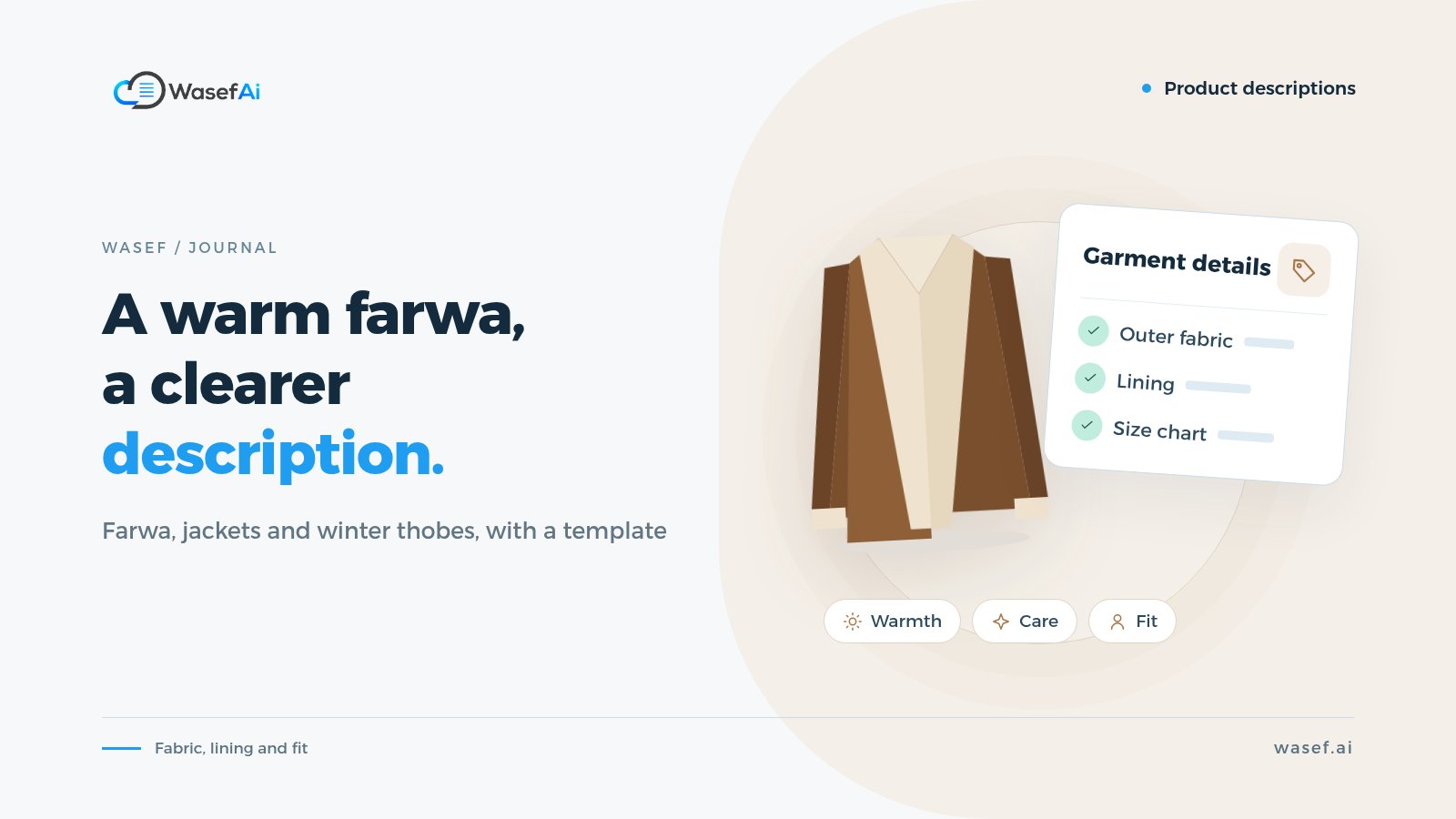
What goes into a good winter clothing description? Five core details: the outer fabric and its composition (such as "70% wool, 30% polyester"), the lining or fill (natural fur, faux fur, down or synthetic fill), a size chart in centimetres rather than just S, M and L, the care instructions exactly as they appear on the label, and who the piece suits and when. Together they make up for what a shopper does in a store: feel the fabric, try it on and look at the lining inside.
Demand for the farwa, jackets and winter shemaghs rises sharply when the cold arrives. Shoppers in Saudi Arabia search Google for "men's farwa", "women's farwa", "men's winter jacket" and "winter shemagh" thousands of times a month, and most of those searches happen between November and January. So your winter product pages need to be ready before the peak, not halfway through it.
This guide walks through each piece: the farwa, the winter thobe and shemagh, the jacket, and kids' clothing. Then you'll get a size chart you can rely on, a ready-made template and two examples.
Why do shoppers hesitate to buy winter clothing online?
Because winter pieces are relatively expensive and raise a lot of questions. Is it actually warm, or does it just look warm? Heavy or light? Is the lining natural or synthetic? Does it run large or small? Can it be washed at home, or does it need a dry cleaner?
If they can't find the answer on your page, they have two options: message you on WhatsApp and wait, or leave and buy from a store that explained more. A clear description makes the second option less likely, and it also cuts down on orders returned because of size.
How to describe a men's or women's farwa
The farwa (فروة) is a traditional long cloak, similar in shape to the bisht, but lined inside with fur or fleece and worn when the cold gets serious. The most important thing a shopper wants to know is exactly what the lining is, because it determines the warmth, weight and price. These are the types the market knows:
- Tufailiya farwa (الطفيلية): made from the skins and wool of young lambs. Known for being light and soft, and one of the most expensive types.
- Farwa from older sheepskin: the wool is longer and the farwa is heavier. Some markets call it "da'am" (الدعم).
- Faux fur farwa: lined with synthetic fibres, cheaper, and often easier to care for. Many women's farwas come embroidered and decorated.
- Sadriya (الصدرية): a short version of the farwa, closer to a vest (sideiri). It suits people who want the warmth without the full length.
The rule here is simple: don't write "natural fur" unless you're sure, either from the supplier or from checking it yourself. A shopper who pays for natural fur and receives faux fur doesn't just return the piece. They write a review and tell others. If the fur is synthetic, say so clearly, along with its real advantage: a lower price, less weight or easier cleaning.
After the lining, add these details:
- Outer fabric: its type and colour, and whether the edges have embroidery or metallic trim (zari).
- Length: in centimetres from the shoulder to the hem, because "long" means different things to different people.
- Weight: if you can weigh it, give the approximate weight. That number matters a lot to someone who'll wear it for hours on a desert trip (kashta) or in a majlis.
- Who it's for: men, women or kids, because those are exactly the words shoppers search with.
Winter thobes and shemaghs: what sets them apart from summer ones?
The thobe is the long robe worn by Saudi men, and the shemagh is the patterned head cloth worn with it. Shoppers already know what both look like, so what they need from you is the difference in fabric. Include:
- Fabric composition with percentages: wool, a wool and polyester blend, or heavy cotton. Copy it from the garment's label instead of guessing.
- Thickness and feel: is the fabric heavy? Soft? Slightly brushed? These words convey the feel that a photo can't.
- Colour and cut: the collar, sleeves and pockets of the thobe, and the shemagh's size and embroidery.
- Is it made to measure? If you sell ready-made or tailored thobes, list the available sizes or the measurements you need from the customer.
Winter jackets: how to describe fill and warmth without made-up numbers
A jacket keeps you warm because of its fill, so that's the most important line in the description. There are two main types:
- Down: lighter and warmer for its weight, and it compresses easily. But when it gets wet, it loses much of its ability to insulate.
- Synthetic fill: usually a little heavier for the same warmth, but it stays warm when wet and dries faster.
If the supplier lists a number like "650 fill power", understand it before you copy it. Fill power measures the quality and loft of down, and it applies only to down, not synthetic fills. A higher number doesn't always mean a warmer jacket, because warmth also depends on how much down is inside the jacket, in grams (the fill weight). If you have both numbers, list them together.
And watch out for claims like "withstands down to minus 20". If the manufacturer didn't state it and you can't show it to the customer, delete it. Instead, describe the use you know: "Suits cold nights in Riyadh and desert trips, with room for a thobe or a light sweater underneath."
Kids' winter clothing: size, fabric and safety
Someone buying for their child thinks about three things: will it fit? Is the fabric comfortable on their skin? And is there anything on it that could hurt them?
- Size by age and in centimetres: "4 to 5 years" alone isn't enough, because children vary. Add the child's height in centimetres and the chest width.
- Inner fabric: which layer touches the child's skin? Cotton? Fleece? That's often a parent's first question.
- Fastening: zip, snaps or buttons. Product safety authorities treat drawstrings around the neck and hood as a strangulation hazard for children. The US Consumer Product Safety Commission, for example, bans them in jackets in sizes 2T to 12. If your clothing has no neck drawstrings, mention it.
- Easy washing: kids' clothes get washed a lot, so say whether it's machine washable and at what temperature.
Size charts: don't just write "one size"
Most clothing returns come down to size. The fix is a size chart you measured yourself on the actual piece, not a generic chart copied from somewhere. Lay the garment flat on a table and record for each size:
- Length: from the top of the shoulder to the hem.
- Chest width: from armpit to armpit, with the garment closed.
- Sleeve length: from the shoulder to the end of the sleeve.
- Shoulder width: especially for jackets and farwas.
Add a line like: "We took these measurements ourselves, and they may vary by 1 to 2 cm." A fit tip makes a big difference too: "It's a loose cut, so size down for a closer fit." If you have a model wearing the piece, give their height and the size they're wearing.
Fabric and care: what do you need to include?
Saudi Arabia's technical regulation for textile products requires a label on the garment, in Arabic or in Arabic and English, showing the fibre composition by name and percentage, care instructions, country of origin and size. So most of the information you need is already on the label. Copy it into the description as it is, because a shopper online can't turn the garment over and read it.
For care, be specific: "Machine wash at 30°C", "Dry clean only" or "Do not tumble dry". With natural fur farwas in particular, follow the supplier's instructions to the letter, and don't write "easy to wash" on your own.
Honest ways to describe warmth
Everyone writes "very warm". Make it mean something by tying it to a reason:
- "Warm because the thick fur lining covers the whole back and both sleeves."
- "Light for how warm it is, because the fill is down."
- "The fabric is heavy wool, so it's made for real cold and may be too heavy for Jeddah's weather."
- "The hood and elastic cuffs keep cold air out."
The third line in particular builds trust: when you tell a shopper when a piece won't suit them, they believe you more when you say when it will. For ready-made lines to work from, see our marketing phrases for online stores.
Which photos does a winter piece need?
- A photo of the lining inside, especially for farwas and jackets.
- A close-up of the fabric showing the weave and texture.
- A photo of the piece being worn, with the model's height and size in the description.
- Detail shots: embroidery, zip, pockets and the label.
You can take them with your phone. We explain how in our phone product photography guide.
A ready-made winter clothing description template
Copy this template and fill it in for your piece. Delete any line you don't have confirmed information for:
- Opening line: what the piece is, who it's for and when it suits. (Example: "A full-length men's farwa for cold nights and desert trips.")
- Outer fabric: the fabric type and composition, as on the label.
- Lining or fill: natural or faux fur, down or synthetic fill.
- Warmth and weight: described with a reason, plus the approximate weight if you know it.
- Details: fastening, pockets, embroidery, hood.
- Sizes: a chart in centimetres, plus a fit tip.
- Care: as it appears on the label.
- Country of origin and available colours.
- Exchanges: one line about size exchanges, with a link to your policy.
If you sell the same piece in several sizes or colours, use product options in Salla instead of a separate product for each size. You'll find templates for other categories in our product description templates.
Two winter clothing description examples
The products below are hypothetical. They show how the template reads once it's filled in.
Example 1: a men's farwa with faux fur lining
"Samar" Men's Farwa, brown, faux fur lining
A full-length farwa for cold nights, desert trips and outdoor gatherings.
- Outer fabric: 100% polyester, with gold embroidery along the edges.
- Lining: thick faux fur covering the back and sleeves, lighter than a natural fur farwa.
- Weight: about 2 kg in size L.
- Sizes: M is 135 cm long, L is 140 cm and XL is 145 cm. It's a loose cut so it can be worn over a thobe.
- Care: dry clean only.
Example 2: a kids' winter jacket
"Dafa" Kids' Hooded Jacket, navy
A winter jacket for school and outings, for ages 3 to 8.
- Fill: synthetic fill that stays warm if the jacket gets wet and dries quickly.
- Inside: a soft fleece lining at the neck and hands.
- Fastening: front zip, and a hood with no drawstrings.
- Sizes: 3–4 years (child's height 98–104 cm), 5–6 years (110–116 cm), 7–8 years (122–128 cm).
- Care: machine wash at 30°C, do not tumble dry.
Notice that neither example says "the warmest jacket on the market". Every line answers a question the shopper would otherwise have asked.
Size exchanges: tell shoppers before they ask
A shopper torn between two sizes relaxes when they know an exchange is possible. Write a clear line in the description about your size exchange conditions (for example, that the piece must be unworn and still have its label), and link it to your full policy. If you don't have a written policy yet, use our return and exchange policy template.
SEO tips for winter clothing pages
- Use search words in the product name: "Men's farwa, brown, faux fur lining" is clearer to shoppers and to Google than "Samar farwa". Shoppers search for terms like "men's farwa" (فروة رجالي), "women's farwa" (فروة نسائية), "men's winter jacket", "winter shemagh" and "winter thobe".
- Page title and meta description: include the type of piece, who it's for and the fabric. Our guide to Salla's product SEO fields explains each field.
- Get ready before the peak: searches for farwas and jackets start rising in October and peak in December. A page you publish early has time to show up in Google.
- Don't repeat the same description for every colour: make the colours options on one product with one strong description.
If you sell other winter products, see heater descriptions and kashta and camping gear descriptions. To see what a product page of yours is missing right now, try our free SEO check for Salla product pages.
Have a whole winter collection to describe?
If you need to prepare dozens of pieces before the cold sets in, writing by hand takes time. Wasef is a Salla app that drafts product descriptions from your product data, in Arabic and English, along with an SEO title and meta description. You review the draft and check the fabric and sizes before publishing, because you're the only one who has actually handled the piece. There's a 7-day free trial with no card required.
Sources
Tags
Before your next campaign, review your product pages with this checklist
Five steps on one page: what to check in your descriptions, how to fill in the SEO fields, and when to add a promotional title. Print it and work through it product by product.
Product page prep checklist
Ready before your next campaign
- Pick the products that will carry the season
- Review every page on mobile
- Fill in the SEO fields in product settings
- Promotional title: honest and temporary
- Spread the work over six weeks