How to Write an Oud and Bakhoor Description: Oud Types, Dukhoon and a Template
How to describe oud or dukhoon so shoppers know exactly what they'll get before they burn it: natural vs. enhanced vs. scented oud, origin, weight in tola and grams, and honest wording for scent and smoke, plus a template and two examples.
Wasef Team
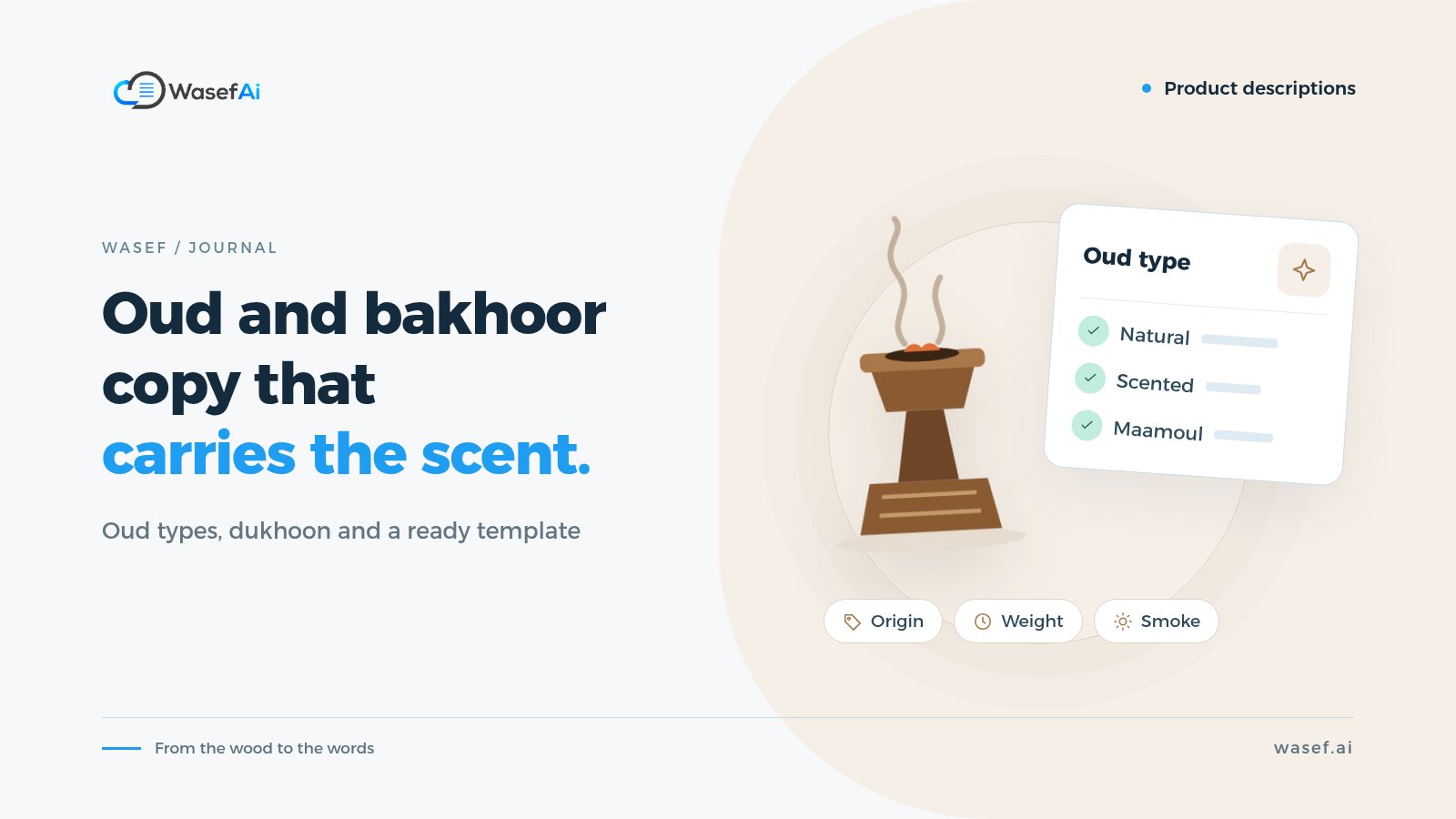
What should an oud or bakhoor description include? Six details: a clear product type (natural oud, enhanced natural oud, scented oud, dukhoon or maamoul), the origin, such as Cambodian or Indian, the weight in grams even if you sell by the tola, the size and shape of the pieces, an honest description of the scent and how the smoke behaves, and how and when to use it. Together they answer the shopper's first question: "What exactly am I going to receive?"
In an oud market, a customer picks up a piece, smells it, and asks the seller to burn a small chip before deciding. Online, all of that disappears. They're left with a photo, a price and the words you wrote. In a category where prices start at a few riyals and run into the thousands, any vagueness in the description makes shoppers hesitate, or buy and then return the product unhappy.
This guide walks through the types of oud and incense your description needs to tell apart, how to state origin and weight, and how to describe scent and smoke in words shoppers will believe. Then you'll get a ready-made template and two examples.
A few terms first, if they're new to you: oud (also called agarwood) is a fragrant resin-filled wood burned for its scent. Bakhoor (بخور) and dukhoon (دخون) are Arabic words for incense burned on hot coals. A mabkhara (مبخرة) is the burner it's placed in, and a tola is a traditional unit of weight that oud is often sold in.
Natural, enhanced or scented oud: what's the difference?
This is the first question your description has to answer, because the names sound similar while the prices are far apart. Traders in Riyadh's Al-Zal market divide oud into three main types, according to a report in the Ajel newspaper:
- Natural oud: wood from Aquilaria trees in which resin has formed. When the tree is infected by a fungus, it produces a resin that turns its pale, scentless wood dark and saturated. It's the most expensive type, and its price varies widely with quality and how much oil the wood holds.
- Enhanced natural oud: traders say its scent is close to natural oud but doesn't last as long, and that its pieces give off a similar scent to one another. It costs far less than natural oud.
- Synthetic or scented oud: ordinary wood with an added fragrance or resin. It's the cheapest, and its pieces often look alike because they're manufactured.
What does this mean for your description? Put the type by name in the product title and in the first line of the description. If your product is enhanced or scented, say so clearly instead of hiding it behind the word "luxury". A shopper who buys scented oud knowing it's scented will be happy with the price and the scent. One who thought it was natural and finds out later is the one who returns it and leaves a negative review.
The good news is that shoppers search for these types by name: "natural oud" and "scented oud" (عود طبيعي and عود معطر) are both terms people type into Google. So being clear here helps you in search, too.
What's the difference between bakhoor, dukhoon and maamoul?
Here the names vary from region to region and from store to store. Many people use "bakhoor" and "dukhoon" loosely for anything placed on hot coals for its scent, while "maamoul" (معمول) usually means a kneaded blend of aromatic ingredients. There are other kinds of incense too, such as resins like frankincense and myrrh, and sticks that burn on their own.
Because the same word means different things to different shoppers, don't rely on the name alone. State in the description:
- The product's form: wood pieces, tablets, paste, powder or sticks.
- The main ingredients: the ones you can confirm with your supplier or from production, such as "contains oud, musk and amber".
- How to burn it: on charcoal, in an electric burner, or both.
If you also sell incense burners, note that "mabkhara" (مبخرة) is a heavily searched term. Burner descriptions need different details: the material, the size, how it's powered (charcoal, mains electricity or rechargeable) and how to clean it.
How to state oud origin: Cambodian, Indian, Merauke
Shoppers search by origin a lot: "Cambodian oud", "Merauke oud" (عود مروكي) and "Indian oud" all get steady monthly searches. Well-known oud-producing areas in South and Southeast Asia include India, Vietnam, Thailand, Cambodia, Malaysia and Indonesia.
There are common descriptions for each origin, such as Indian being sharper with a leathery character and Cambodian being sweeter and smoother. But be careful: most of these descriptions are written about oud oil in the perfume world, and the piece in your hands may differ. So stick to two rules:
- State the origin as your supplier gives it, and if you can't confirm it yourself, write "according to the supplier". That short phrase protects you and respects the shopper's intelligence.
- The scent description should come from your own experience of the piece, not from a general description of its origin.
Tola or grams? How to state weight and piece size
"Tola of oud" (تولة عود) is a term shoppers search for, so the tola should appear in your description. But not every shopper knows how much it weighs. The common figure for a tola is 11.66 grams, and some markets use slightly different values. The fix is simple: write both, such as "1 tola (11.66 g)", or give the weight in grams with the tola in brackets. The same goes for other traditional units: put the weight in grams next to them.
After the weight, state the size of the pieces: small chips, medium pieces or large pieces. The same weight could be two large pieces or twenty small chips, and the experience is different. A photo of the pieces next to a coin or a ruler shows size better than any description. And if you sell the same oud in several weights, use product options in Salla instead of creating a separate product for each weight.
How to describe the scent and smoke of oud
Burn a piece yourself before you write, and note what you notice at each stage:
- The first minute on the coal: is the scent sharp, smoky, or smooth from the start?
- After a few minutes: many types settle and reveal some sweetness or a deeper woody character.
- The smoke: thick or light? Better for a large majlis (sitting room) or a small room?
- How long it lingers: how long the scent stayed in the room or on clothes in your own test.
Instead of "a luxurious scent", use more precise words, as long as they're true for your product: woody, smoky, sweet, honeyed, leathery, sharp, smooth, camphorous, warm. For ready-made marketing lines for oud and incense, see the section in our marketing phrases for online stores.
Also mention how you tested it: "on charcoal" is different from "in an electric burner". That detail helps the shopper understand why the scent might come out a little differently at home.
A ready-made oud or dukhoon description template
Copy the template and fill it in for your product. Delete any line you don't have confirmed information for:
- Opening line: the type and the character of the scent in one sentence.
- Type: natural, enhanced natural, scented, dukhoon or maamoul.
- Origin: with "according to the supplier" if you can't confirm it yourself.
- Weight: in grams, plus the tola if you sell by it.
- Form and piece size: small chips, medium pieces, tablets or paste.
- Scent and smoke: what you notice as soon as it goes on the coal, after a few minutes, and how thick the smoke is.
- When it suits: daily use, welcoming guests, occasions, or scenting clothes.
- How to use it: charcoal or an electric burner, and how many pieces are enough.
- Packaging and storage: the type of box, and how the shopper should store it.
Two oud and dukhoon description examples
The products below are hypothetical. They show how the template reads once it's filled in.
Example 1: enhanced natural oud
"Samar" Cambodian Enhanced Natural Oud, 1 tola (11.66 g)
An enhanced natural oud with a sweet woody character, suited to the home and to welcoming guests.
- Type: enhanced natural, not pure natural.
- Origin: Cambodia, according to the supplier.
- Pieces: medium chips, each roughly the size of a fingertip.
- Scent: in our test on charcoal, it opens woody with visible smoke, and after about two minutes a light sweetness comes through.
- How to use: one or two chips are enough for a medium-sized majlis.
Example 2: maamoul dukhoon
"Winter Nights" Maamoul Dukhoon, 50 g jar
A warm maamoul blend with oud, musk and amber, suited to scenting clothes and the home.
- Form: a soft paste in an airtight jar.
- Scent: sweet and warm from the moment it goes on the coal, with lighter smoke than oud chips.
- How to use: a piece the size of a lentil is enough, on charcoal or an electric burner.
- Storage: close the jar tightly after each use so the paste doesn't dry out.
Notice that neither example says "the finest oud on the market" or "100% original". Every line gives the shopper information they can base a decision on.
Words and claims to avoid in oud descriptions
- "100% original" or "pure natural" when you can't prove it.
- Grades like "super" and "double super" without explaining what they mean in your store. A grade without a definition tells the shopper nothing.
- Promises that the scent will last for days on clothes.
- A generic, copied origin description repeated across all your products.
- Hiding the real weight, or giving the tola without grams.
One more point if you import oud yourself: all Aquilaria species are listed under CITES, the convention that regulates trade in endangered species, so check your supplier's paperwork.
SEO tips for oud and bakhoor product pages
- Product name: include the type, origin and weight, such as "Cambodian Enhanced Natural Oud, 1 Tola". These are the same words shoppers type into search.
- Page title and meta description: use terms like "natural oud" or "maamoul dukhoon" to match your product. Our guide to Salla's product SEO fields explains each field.
- Photos: a close-up of the pieces showing their color and texture, a shot next to something that shows size, and a photo of the box. See our phone product photography guide.
- A different description for each product: don't repeat the same paragraph across twenty types of oud and change only the name.
If your store also sells oud oil and perfume, the approach is a little different, and we cover it in our perfume description guide.
To see what a product page of yours is missing right now, try our free SEO check for Salla product pages.
Should you write descriptions yourself or use AI?
Both work, as long as the information comes from you. AI hasn't burned the piece, and it doesn't know whether it's natural or enhanced. Give it the type, origin, weight and your impression of the scent and smoke, and let it handle the wording. We explain exactly what to give it in our AI product description prompt guide.
Wasef is a Salla app that drafts product descriptions from your product data, in Arabic and English, along with an SEO title and meta description. You review and edit the draft before publishing. There's a 7-day free trial with no card required. For templates for other categories, see our product description templates.
Sources
Tags
Before your next campaign, review your product pages with this checklist
Five steps on one page: what to check in your descriptions, how to fill in the SEO fields, and when to add a promotional title. Print it and work through it product by product.
Product page prep checklist
Ready before your next campaign
- Pick the products that will carry the season
- Review every page on mobile
- Fill in the SEO fields in product settings
- Promotional title: honest and temporary
- Spread the work over six weeks